What is Color Flood?
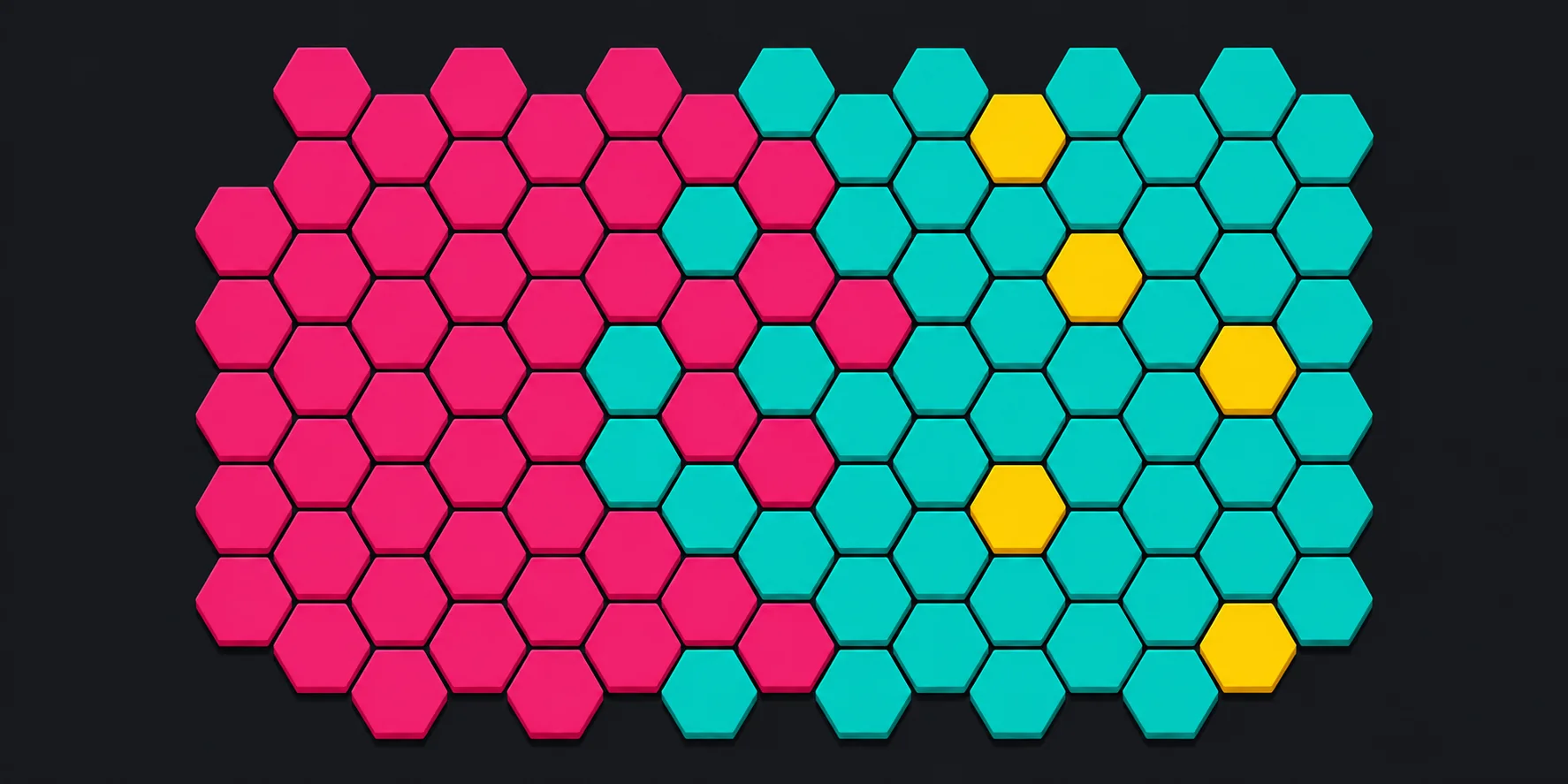
Color Flood is a fast, deterministic logic puzzle. Imagine the screen as a coloured grid of cells — your “territory” starts as the single cell in your corner. Each turn:
- Pick one of the available colours.
- Your territory immediately changes to that colour.
- Any cells adjacent to your territory in that new colour also become yours.
- The flood continues outward until no more adjacent cells of the new colour exist.
In a two-player version (the variant Pop Play uses), each player works from their own corner and competes to claim more of the board. After a fixed number of turns, the player with more territory wins.
In single-player solo mode, you try to flood the entire board in as few turns as possible.
How to win
In two-player mode: after the move limit (a fixed number per player, usually 22-30 depending on board size), the player whose territory covers more cells wins. Ties go to the player who claimed the centre last.
In solo mode: flood the entire board within a target number of turns.
A turn
Per turn:
- From the colour palette (typically 6 colours), pick the one you want to claim.
- Your territory absorbs all adjacent cells of that colour, recursively.
- The board updates instantly.
- Pass the turn (in two-player) or count up your turn (in solo).
You cannot pick the colour your territory currently is — that would do nothing. Some implementations also forbid picking the colour your opponent’s territory currently is (so you can’t poach by impersonating them).
A worked example
Imagine a tiny 4×4 board. Colours: R, B, G, Y. Your starting corner is top-left.
R G B Y
G R G B
B G R Y
Y B Y R
Your territory: the top-left R cell only.
Turn 1: You pick G. Your top-left becomes G. The cell to the right of it (G) is adjacent and same colour — flood. The cell below (G) is also adjacent — flood. Now check those new G cells for new G neighbours: there’s another G two steps right — but that G is only reachable via a B in between, so doesn’t flood.
After turn 1, territory: 3 cells.
[G][G] B Y
[G] R G B
 B  G R Y
 Y  B Y R
Turn 2: You pick R. Your three G cells become R. The R at row 2 col 2 is adjacent to your row 1 col 2 → flood. After flooding, check that R for new neighbours… and so on.
Each colour pick can chain quite far, depending on board layout.
What makes Color Flood great
Three things:
- Deterministic — every position has a single best move (or a few equally-good moves). It’s a pure logic puzzle, not a game of chance.
- Fast — each move resolves in less than a second; matches finish in 1-3 minutes.
- Search-friendly — the game is a beautiful introduction to flood-fill algorithms and breadth-first search. Strong play looks like deliberate set-piece thinking; weak play looks like random colour selection.
In two-player mode, the strategic question becomes: which colour pick maximises my gain while minimising the gain my opponent could make next turn? That trade-off — selfish gain vs. denial — gives the game its competitive edge.
Color Flood’s history
Color Flood is a modern game — its rules emerged from the flood-fill puzzle tradition that became popular in the late 2000s and early 2010s as small mobile games and web puzzles. The most famous implementation, simply called Flood-It!, was released by Lab Pixies on web and mobile in the late 2000s and became a viral hit, spawning a wave of similar games.
The mathematical structure of the puzzle has been studied as a special case of flood-fill on a coloured graph. The single-player problem of flooding an N×N board with K colours in the minimum number of turns is computationally hard in the general case — meaning no known efficient algorithm guarantees an optimal solve for arbitrary large boards. For the small boards used in actual play, modern search algorithms find optimal solutions in milliseconds.
The two-player competitive variant — used by Pop Play — adapts the single-player puzzle into a head-to-head race. Multiple variant rule sets exist; Pop Play uses the standard “claim from opposing corners, fixed move count” version.
Color Flood strategy primer
What separates random clicking from solid play:
1. Big-region grabs first
If picking colour X right now floods 12 cells but picking Y only floods 2 cells, the math seems obvious — but you also have to consider the next turn. Sometimes a smaller grab now sets up a much bigger grab next turn.
Heuristic: when the size difference is large (>5 cells), take the bigger grab. When it’s small (1-2 cells), look ahead.
2. Look one move deep
After each pick, mentally simulate “if I pick this colour, what’s the best move I’d have NEXT turn?” If a colour dramatically expands your future options, prefer it.
3. Watch the opponent’s frontier
In two-player mode, your opponent’s territory has a frontier — the cells just outside their current claim. Picking colours that match colours along their frontier helps them; picking colours that don’t match anything on their frontier denies them future flood paths.
4. Avoid mirror-traps
If you and your opponent always pick the same colour, you both grow at similar rates and the game ends close to a tie. Diversify your picks to break out.
5. Centre control matters less than in most games
Unlike chess or Go, the centre of the board isn’t intrinsically special — any cell connects to at most four neighbours. What matters is connected colour regions — large clusters of the same colour are valuable territory worth racing for.
Color Flood on Pop Play
Pop Play implements two-player Color Flood:
- Smart bot opponents — easy bots play locally optimal; hard bots use 2-3 ply search.
- Online multiplayer — race against another human in real time.
- Themed worlds — Candy Kingdom, Alien Planet, Neon Cyberpunk, Celestial Palace are all natural fits for a colour-driven game.
- Animated flood — colour cascades with smooth animation so you can see exactly where the territory expanded.
Frequently asked questions
How long is a Color Flood match?
Two-player matches finish in 2-4 minutes typically. Single-player solves take 30 seconds to 2 minutes per board.
How many colours are on the board?
Usually 6 colours. Pop Play uses 6.
Can I pick the colour I currently am?
No — that would do nothing. The app blocks self-colour picks.
Is Color Flood solved?
For small boards (up to ~12×12) yes — modern search algorithms find optimal solutions in milliseconds. The general flood-fill optimisation problem is computationally hard for arbitrarily large boards, but the boards used in actual play are well within the solvable range.
How do I beat the hard bot?
Look two moves ahead. The hard bot plans for the next 2-3 turns, so reactive play loses. Pick moves that compound — your turn 3 should benefit from your turn 2’s choice.
Where can I play Color Flood on mobile?
Pop Play has it free with two-player mode. Multiple “Flood It”-style apps exist on iOS and Android with varying ad density; Pop Play’s version is free without ads.