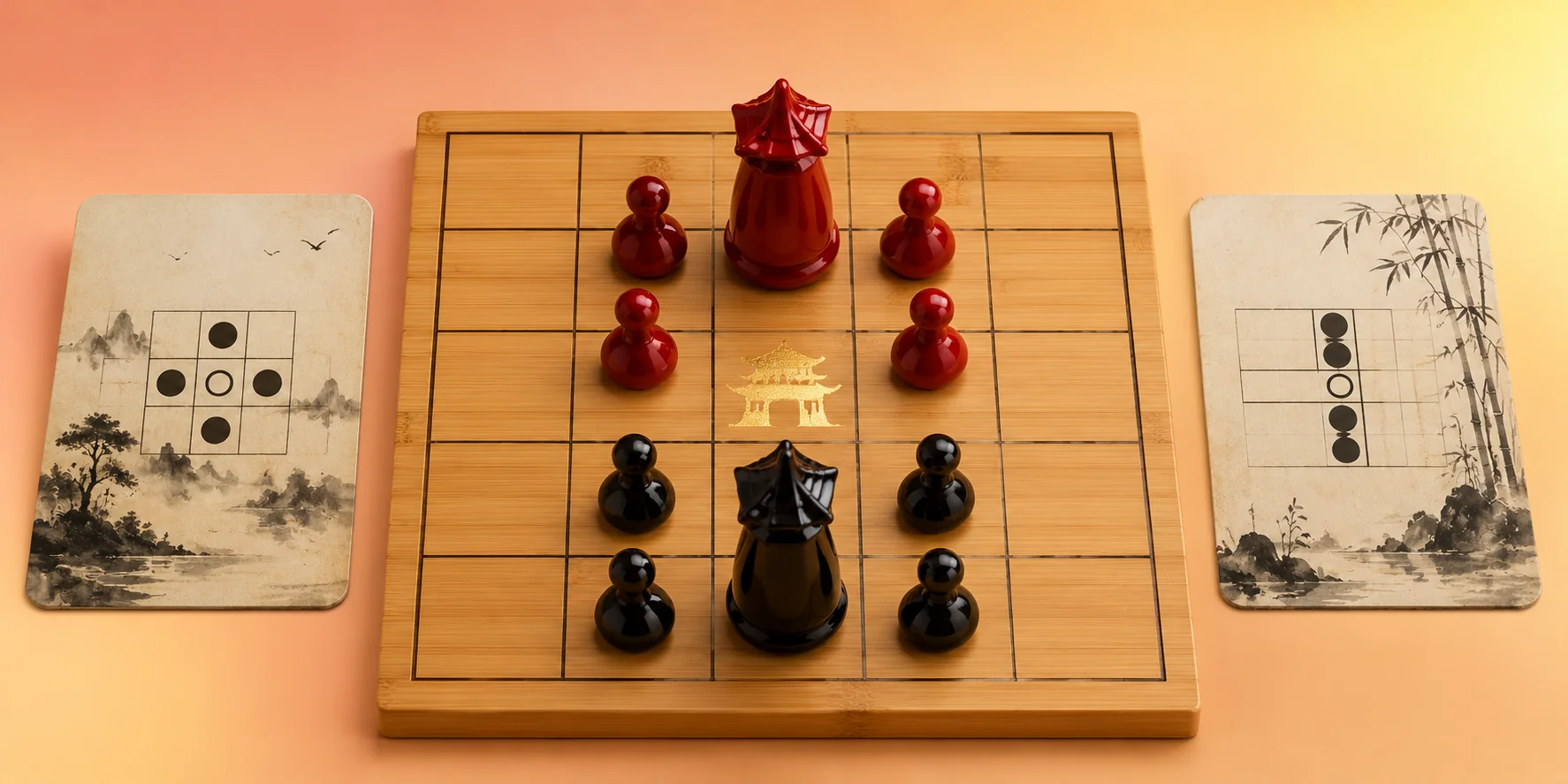
What is Onitama?
Onitama is a two-player game where each side controls one master and four students on a 5×5 board, and uses movement cards drawn from a shared pool of 16 to move pieces. There are no dice, no hidden information except your opponent’s plans, and no luck once the cards are dealt.
Each turn you do exactly two things: pick one of your two cards, move a piece using its pattern, then pass that card to a fifth slot in the centre — the transit slot — and pick up whatever card was already there. Your opponent gets the card you just played, on their next turn.
That single mechanic — every move you make hands a tool to the other side — is what makes Onitama feel deeper than its 5×5 board suggests.
How to win Onitama
You win in one of two ways:
- Way of the Stone — capture the opposing master by moving any of your pieces onto their square.
- Way of the Stream — move your master onto your opponent’s starting temple square (the centre square of their back row).
There are no points, no time limit beyond what the app or table sets, no draw mechanic. One of the two win conditions ends the game.
Setting up the game
The board is a 5×5 grid. Each player begins with five pieces lined up on their back row:
- Master — centre square, marked clearly. Lose this and you lose the game.
- Students — four pieces flanking the master.
Five cards are drawn from a deck of 16. Each player gets two; the fifth sits in the centre transit slot. That fifth card determines who plays first — there’s a small symbol on every card indicating whether red or blue moves first when that card is the centre card.
In Pop Play the deal is automatic. On the physical version, you shuffle and deal once at the start.
Movement cards: the heart of the game
This is the part Onitama gets very right. Each of the 16 cards in the deck shows a small grid with one or more highlighted squares. Those highlighted squares are exactly the moves a piece can make using that card — relative to the piece, not the board.
So if a card shows two squares forward and one square diagonally forward-left, any of your five pieces can be moved to one of those two destinations (as long as the destination square doesn’t contain one of your own pieces). The card doesn’t care which piece moves.
Every card has a name (Tiger, Crab, Monkey, Mantis, etc.) and a colour stripe — red or blue — matching the player who goes first when it sits in the transit slot at the start.
You always move exactly one piece per turn. After moving, you slide the card you used to the transit slot and pick up the card sitting there. Your opponent draws that card next turn. There is no card cycling beyond that.
What a turn looks like
Concretely:
- Look at your two cards. Decide which to play.
- Pick one of your five pieces and move it according to that card’s pattern.
- If your move lands on an opponent’s piece, capture it (their piece is removed from play).
- Slide the played card to the centre transit slot.
- Pick up whichever card was in transit. That’s now in your hand.
- Pass the turn to your opponent.
If you can’t make a legal move with either of your two cards (rare — happens when you’re cornered or restricted), you must still pass a card to the centre. You play a card, swap nothing on the board, and your turn ends. This is called a “stuck move” and exists so the game never deadlocks.
What makes Onitama great
The clean answer is information symmetry. Both players see all five cards in play at all times. The only hidden state is intent — what your opponent is planning to do with their two cards. Every game is purely about reading and reacting.
The second answer is brevity. Most games last 5–15 minutes. The 5×5 board means there’s nowhere to hide — every piece is one or two moves from any other.
The third is the card-rotation pressure. The card you play in turn 1 will be in your opponent’s hand by turn 3. So a great move now hands them a great move later. Onitama forces you to think two turns ahead, on both sides.
Onitama’s history
Onitama was designed by Shimpei Sato and published in 2014 by Arcane Wonders (English-language release). The Japanese kanji aesthetic is intentional — each card’s name corresponds to an animal motif drawn from Japanese tradition, and the artwork leans deliberately into a feudal-Japan visual identity.
The design is part of a tradition of low-rules-density abstract strategy games — games that fit on a single instruction card but produce deep emergent strategy. Other games in the same family include Hive and DVONN. Onitama is shorter than both and uses cards instead of piece-type asymmetry to create variety.
The game has been recognised with several awards in the years since, including a Mensa Select seal — given to mind-games judged “exceptional” by a panel of board-game-playing Mensa members.
Onitama strategy primer
A few things to internalize as you start playing:
- Watch the transit card. What you play this turn becomes available to your opponent in two turns. If you give them Tiger — a strong forward-leaping card — and your master is on their forward line, you’ve handed them the win.
- Card-card pairs matter more than card quality. Two complementary cards that cover different directions are stronger than one great card and one redundant card.
- Master positioning is everything. The Way of the Stream win condition means your master walking up the centre is always a credible threat. Conversely, a sleeping master on their home square is a free target.
- Captures aren’t free. Removing a student feels great, but it advances your piece into your opponent’s territory — closer to their pieces and farther from your master, which they can now threaten.
- Plan two moves ahead, both sides. Every move uses the card cycle. Picture the board after this turn AND after the opponent’s reply.
Onitama on Pop Play
Pop Play includes Onitama as part of its 19-game collection — free, no ads, no pay-to-win. Specifically:
- Smart bot opponents at multiple difficulty levels, including a hard AI tuned to threaten Way-of-the-Stream wins.
- Online multiplayer with friends or matchmaking.
- 51 themed worlds that re-skin the board, pieces, and ambient art (full game logic identical) — so the same Onitama match looks completely different in Samurai Temple vs Bamboo Forest vs Cherry Blossom Garden.
- Replay last move + capture animation so you can see exactly what happened on long matches.
Frequently asked questions
How long does an Onitama game take?
Most games last 8–15 minutes. Beginners often finish in 5 minutes once one master makes a clean run.
Is Onitama solved?
Not in a meaningful published sense. The state space is small, but the random card deal means each five-card subset produces what’s effectively a different game — a full solution would need to cover every possible card distribution.
How many cards are there in Onitama?
Sixteen. Every game uses exactly five — two per player and one in transit. Different five-card subsets create wildly different games.
Can two beginners play Onitama?
Yes — the rules fit on a single page and the visible movement cards mean you literally cannot make an illegal move.
Is Onitama better than chess?
Different game. Onitama trades chess’s depth-from-piece-types for depth-from-card-rotation. A 30-minute Onitama game asks more of your tactical-pattern-recognition than a 30-minute chess game; chess asks more of your memorized opening knowledge.
Where can I play Onitama on mobile?
Pop Play includes it free. Several premium digital adaptations of the physical game also exist on iOS and Android — Pop Play’s version is free with no ads.