What is Mancala?
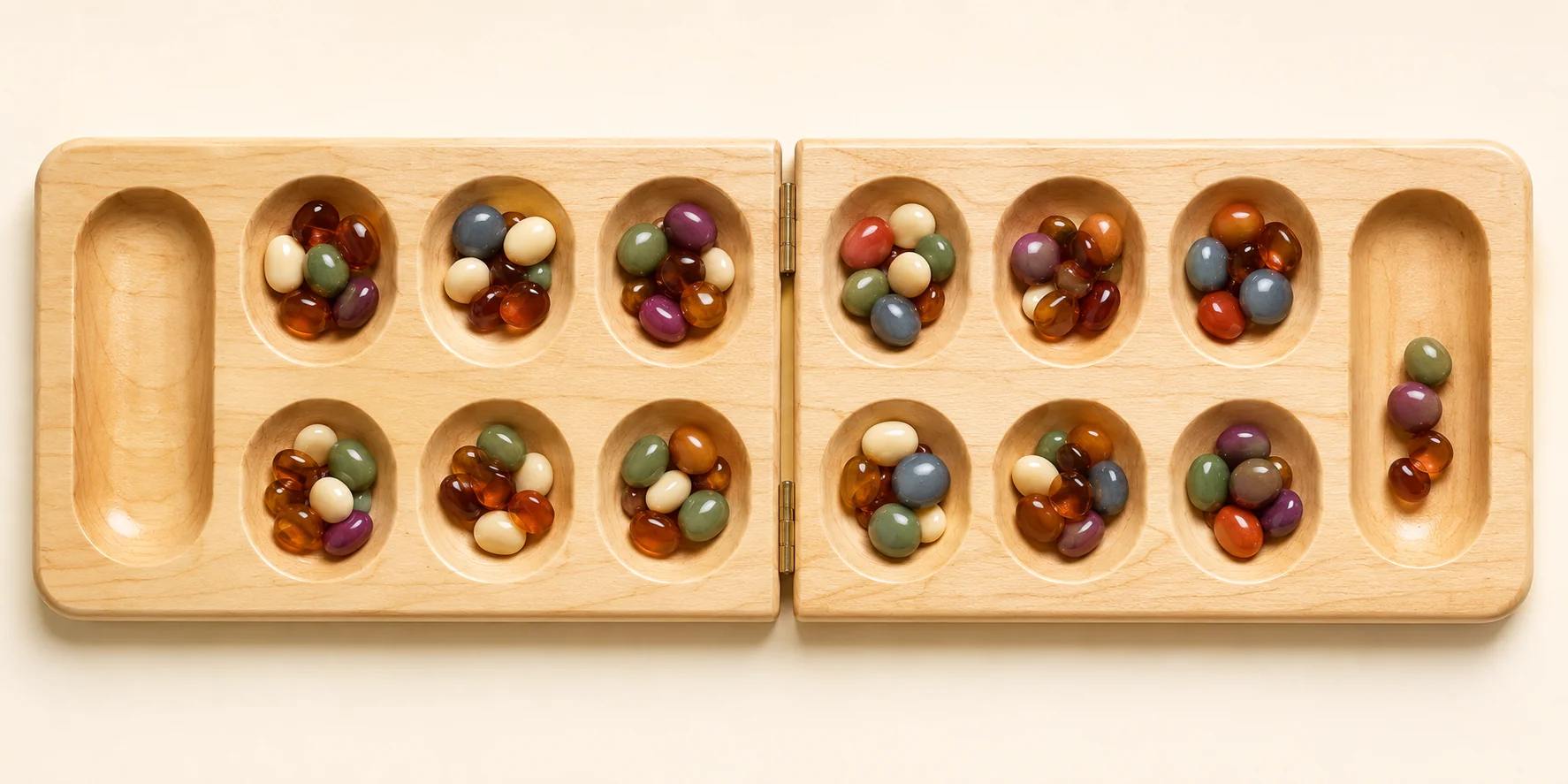
“Mancala” isn’t a single game. It’s a family of board games — a structural pattern shared by hundreds of regional variants played from West Africa to South-East Asia. The shared mechanics are:
- A board with rows of pits or holes.
- Pieces (seeds, stones, beads, cowries) that get redistributed by being picked up and sown one at a time into successive pits.
- A capture rule that triggers when the last seed sown lands in a specific kind of pit.
The version most Westerners learn — with two rows of six pits and one large “store” at each end — is Kalah, an Americanised variant patented in 1940 by William Julius Champion, Jr. Almost every digital “Mancala” app, including Pop Play, plays Kalah.
For everything below, when we say “Mancala” we mean Kalah.
Setting up the board
Two rows of six pits sit between two players, each player owning the row in front of them. At each end of the board sits a larger pit — the store (sometimes called mancala or kalah) — owned by the player on its right.
To start: place four seeds in each of the twelve small pits. The two stores are empty. Forty-eight seeds total. Decide who plays first.
In Pop Play this is automatic. On a physical board, the host picks a side and sets it up; turn order is usually decided by a coin toss or the player who travelled furthest to the table.
How to win Mancala
You win by having more seeds in your store at the end of the game.
The game ends when one player can’t move — i.e. all six of their pits are empty. At that moment, the other player sweeps any remaining seeds from their own row into their own store. Compare the two store totals: highest wins. Twenty-five each is a tie (rare but possible).
How a turn works
On your turn:
- Pick up all the seeds from any one of your six pits.
- Sow them one at a time into successive pits, moving counter-clockwise around the board: into your remaining pits, then into your own store, then across to your opponent’s pits, and so on.
- Skip your opponent’s store. You only ever drop seeds into your own store, never theirs.
Whether anything special happens depends on where your last seed lands.
The four landing rules
These three rules — earned-turn, capture, no-no — are what give Mancala its strategic depth.
Rule 1 — Free turn
If your last seed lands in your own store, you take another turn immediately. Chain these together for big advantages.
Rule 2 — Capture
If your last seed lands in an empty pit on your own side, AND the directly-opposite pit on your opponent’s side has seeds in it, you capture: take that last seed PLUS all the seeds from the opposite pit and put them all in your store.
Rule 3 — Empty-handed
If your last seed lands anywhere else — in a non-empty pit on either side, or in the opponent’s row — your turn ends quietly.
Rule 4 — End condition
When all six of your pits are empty at the start of your turn, the game ends. Your opponent immediately moves all seeds from their row into their store. Compare totals. Higher store wins.
In Pop Play these are enforced automatically — illegal moves are filtered, captures animate, and the game-end is detected the moment a side empties.
A worked example
Let’s walk one move. Say you pick up the four seeds from your second pit (the one second from your left). You sow them counter-clockwise:
- 1st seed → your third pit
- 2nd seed → your fourth pit
- 3rd seed → your fifth pit
- 4th seed → your sixth pit
Last seed lands in your sixth pit. Sixth pit is on your side, but it wasn’t empty before — it had the four seeds it started with, plus your one new seed. So capture rule doesn’t trigger; free-turn rule doesn’t trigger (your last seed didn’t land in your store). Your turn ends.
Now what if instead you’d picked up your third pit (also four seeds)? Sow them: pit 4, pit 5, pit 6, your store. Last seed in your store → free turn. Take another move immediately.
Recognising these patterns is most of the game.
Mancala’s history
The game’s age is genuinely disputed but old by any measure:
- Archaeological evidence of two-row pit boards has been found across Eritrea, Ethiopia, Sudan, and Egypt dating back many centuries. Older claims of multi-thousand-year-old pit-board finds in the Levant exist in popular sources, but the dating is contested among archaeologists — some pit-rows that look like proto-mancala boards may have been used for counting, divination, or other purposes entirely.
- Spread. From its African origins, mancala-family games spread along trade routes: north into the Middle East (where it’s called Mangala in Arabic), east to South and South-East Asia (Pallanguzhi in Tamil Nadu, Congklak in Indonesia, Sungka in the Philippines), and south through Africa (Bao in Tanzania, Oware in Ghana).
- Modern Kalah. The two-row, six-pit, one-store-per-side variant most Westerners know was named Kalah and patented by William Julius Champion, Jr. in 1940. Champion’s marketing pitched it as “the game of yesterday — and tomorrow,” which is reasonable given the lineage.
- Computer solve. Smaller Kalah variants — boards with fewer seeds per pit — have been completely solved by computer, with the first player winning under optimal play. The full standard 6-pit, 4-seed-per-pit variant was solved in the early 2000s by Geoffrey Irving and Jeroen Donkers — first player wins by a substantial margin under perfect play.
So when you play Mancala on your phone you’re playing a game whose family has outlived empires and whose modern variant has been mathematically solved. The strategy is still hard for humans because the search tree branches fast.
Mancala strategy primer
If you’re starting:
- Look for free turns first. Any move that lands your last seed in your own store buys you another turn. Stack these aggressively in the opening.
- The right-most pit (closest to your store) is gold. Seeds there have the shortest distance to your store. Don’t sow seeds out of it carelessly.
- Defensive captures. Watch which of your own pits are empty. If your opponent has a pit with exactly the right count to land in your empty pit on their next turn, they’re going to capture from yours. Disrupt that count by sowing into either pit.
- Set up offensive captures. Empty pits on your own side aren’t necessarily a weakness — they’re capture traps if you can land your last seed in them.
- Endgame seed-counting. Once seeds get scarce, count exactly. There are usually one or two moves that empty your row at the right moment to leave a big pile for your opponent’s mandatory final sweep — bad for you. Avoid them.
Mancala on Pop Play
Pop Play’s Mancala uses the standard Kalah variant — 6 pits per side, 4 seeds per pit, store on the right, Western counter-clockwise sowing. What it adds:
- Smart bot opponents ranging from learning-friendly to ruthless.
- Online multiplayer with friends or matchmaking.
- Themed worlds — including African Savanna, Egyptian Tomb, Jungle Ruins, and Arabian Nights skins that visually echo the regions where mancala-family games actually emerged.
- Move-replay + chain-capture animation so multi-step capture cascades read clearly.
Frequently asked questions
Is Mancala solved?
Yes, the standard Kalah-6-4 variant is solved. The first player wins with optimal play. Humans, however, find perfect play impractical — the game is still genuinely strategic at human levels.
How long does a Mancala game take?
Around 5–15 minutes per match.
What’s the difference between Mancala and Kalah?
“Mancala” is the umbrella term for the whole family of sowing-and-capturing games. “Kalah” is the specific Americanised 6-pit variant patented in 1940 — the version most digital apps use, including Pop Play.
Can you skip your opponent’s store?
Yes — always. You only sow into your own store, never theirs.
What’s the best opening move in Mancala?
A common strong opening for the first player is to sow from the third pit from the left, which lands the last seed in your own store and grants a free turn. There’s debate about whether second or third pit is optimal; both are well-regarded. Avoid emptying your right-most pit early — it’s your highest-value real estate.
Where can I play Mancala on mobile?
Pop Play has it free. Several other apps exist; Pop Play’s version is free without ads.