What is Abalone?
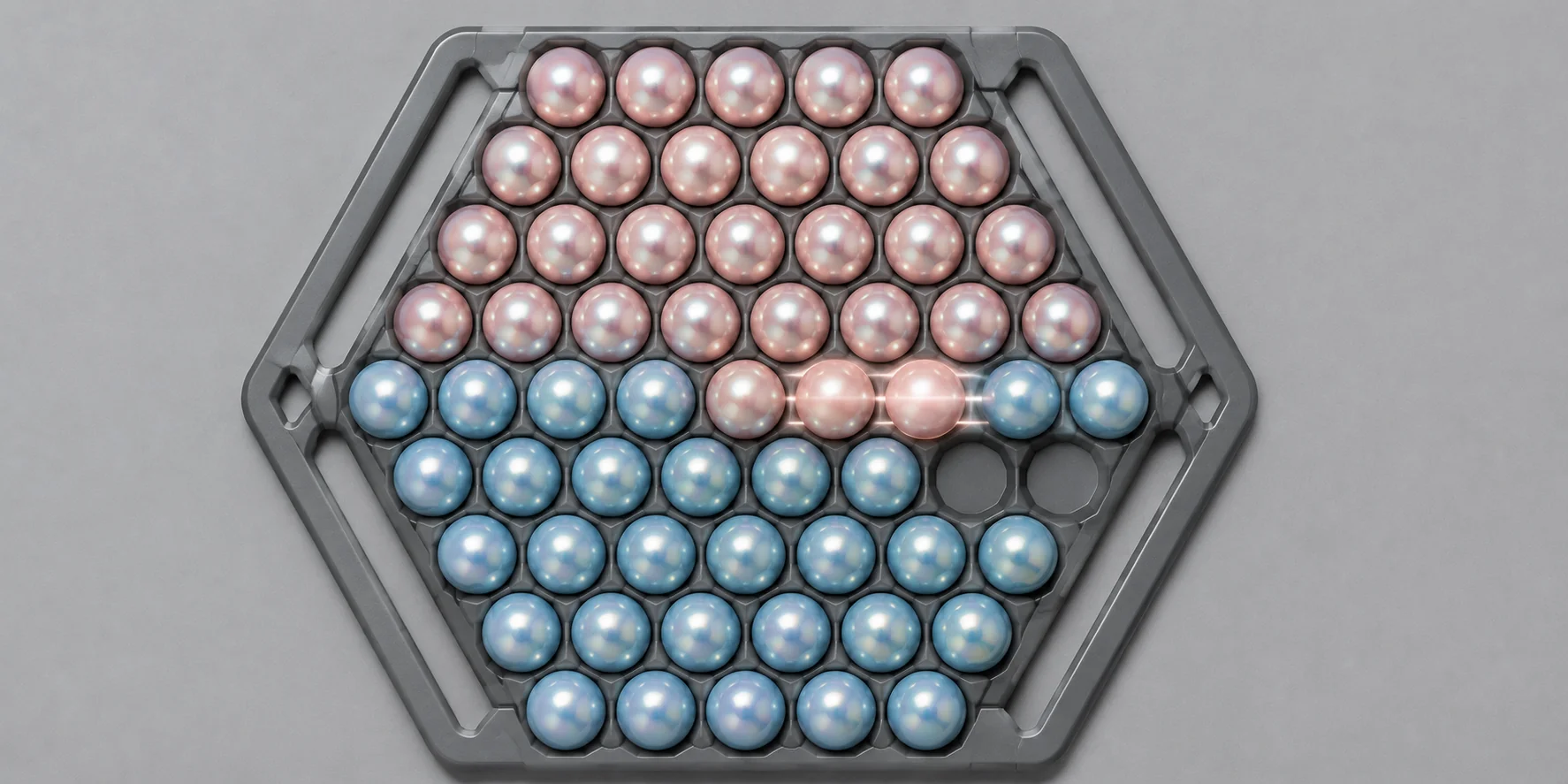
Abalone is a two-player abstract strategy game played on a hexagonal board with 14 marbles per side — black for one player, white for the other. The board is shaped like a hexagon, with five rings of cells and a central hub, totalling 61 cells.
You move marbles in lines (one to three at a time) and you can push opposing marbles when you outnumber them locally. Push enough of your opponent’s marbles off the edge of the board — six is the magic number — and you win.
It’s a perfect-information, no-luck game. Like chess or Onitama, every move is visible and every consequence is deterministic.
The board and pieces
A standard Abalone board is a hexagon with 61 cells arranged in five rings around a centre. Cells use three movement axes — left-right and the two diagonals.
Each player has 14 marbles. The starting position has both sides arranged in a “Daisy” or standard configuration: two rows of five and a row of three on the back. The exact placement is the same every game, so opening play is well-studied.
How to win
You win by pushing six of your opponent’s marbles off the edge of the board. That’s it.
If neither player can achieve this — or if a tournament has a turn limit — there are tie-breaker rules, but in casual play and on Pop Play the only goal is six pushes.
Movement rules
You can move 1, 2, or 3 of your own marbles per turn. Restrictions:
- In-line movement. Two or three marbles being moved together must be in a straight line, all yours, with no gaps. They move together one cell forward (or sideways).
- Side-step movement. A line of two or three marbles can also “side-step” — moving sideways to an adjacent parallel line — as long as none of the destination cells are occupied.
- Single marble. A single marble can move to any adjacent empty cell.
You cannot leave the board through a side-step or normal move; only pushing can put a marble off the board, and only opposing marbles fall that way.
Pushing (the core mechanic)
You push when you outnumber your opponent in a single line:
- 2 vs. 1: two of your marbles can push one of theirs.
- 3 vs. 1: three of your marbles can push one of theirs.
- 3 vs. 2: three of your marbles can push two of theirs.
In all cases the pushed marbles move one cell in the direction of the push. If the marble at the back of the push is at the edge of the board, it falls off — that’s a “score” for the pusher.
You cannot push when:
- You don’t outnumber them. 1 vs. 1, 2 vs. 2, 1 vs. 2, etc. — illegal.
- A friendly marble blocks the back. If your opponent’s pushed line ends at one of your own marbles, the push is blocked.
- You’re pushing your own marbles off. Never. You can only ever push opposing marbles off the edge.
A push always moves the entire line one cell forward — your marbles advance, the opponent’s marbles either move further into their own territory or fall off the back.
A worked example
Imagine a horizontal row from your perspective:
[your marble] [your marble] [your marble] [opponent marble] [opponent marble] [edge]That’s 3-vs-2. You may push them: all five marbles slide one cell to the right; the back opponent marble falls off the edge. You score one. Your three marbles now occupy where their three positions used to be (well, two of yours occupy their two old slots and the third opponent marble is one cell further right).
If instead the configuration had been:
[your] [your] [opp] [opp] [opp]That’s 2-vs-3 — you cannot push. You have to do something else this turn.
What makes Abalone great
Abalone is one of the cleanest examples of spatial-mass strategy. The game is fundamentally about getting more marbles in the right place at the right time. Your marbles are stronger together — a tight hex of six marbles is a fortress; a scattered formation is a target. There’s an almost gravitational pull to keep your formation cohesive, broken only when you commit to a push.
Tactically, the game has a clean dichotomy: defenders cluster at the centre and force attackers to commit; attackers split formations to threaten multiple flanks. Most strong play is about positioning rather than direct conflict.
Abalone’s history
Abalone was designed by Michel Lalet and Laurent Lévi and first published by Abalone S.A. in 1987 in France. The hexagonal board and marble-pushing mechanic were original; the name “Abalone” was associated with the shellfish whose coloured shells the marbles were said to evoke.
The game was a commercial breakthrough. Lifetime sales of physical Abalone boards run into the millions of units — making it one of the best-selling abstract strategy games of the late 20th century alongside Othello/Reversi.
Abalone was a regular World Championship tournament event from the 1990s into the 2000s, with serious play traditions still alive in France, Germany, and the Netherlands.
A computer fully solving Abalone is theoretically tractable but, as of 2026, has not been published — the game’s branching factor is high enough that even modern engines settle for very deep search rather than full enumeration.
Abalone strategy primer
What separates beginners from intermediate players:
- Centre control. The centre cell and its six neighbours form the strongest position. A marble in the centre has six escape routes; a marble on the edge has three. Beginners give up centre too easily.
- Don’t drift to the edge. Once one of your marbles is on the outer ring, your opponent has a path to push it off. Edge marbles are vulnerable.
- Tight formations beat scattered ones. A hex cluster of six marbles can defend against any push because it always has 6-vs-N coverage on every axis.
- Side-step early; push late. Side-stepping moves your marbles without exposing them. Direct pushes are committal — only push when you have a clear material advantage and the opponent can’t easily reciprocate.
- Count to six. That’s the score. Keep mental track of how many of each side has been pushed off. Once one side is at 4 or 5, urgency changes everything.
Abalone on Pop Play
Pop Play implements standard Abalone — 14 marbles per side, hexagonal 61-cell board, six-push win condition. Specifically:
- Smart bot opponents with multiple difficulty levels — the hard AI is genuinely challenging.
- Online multiplayer with friends or matchmaking.
- Themed worlds that re-skin the board and marbles — Crystal Cavern, Medieval Castle, and Frozen Tundra all suit the abstract feel.
- Last-move arrow so chains of pushes read clearly even on small phone screens.
Frequently asked questions
How long is an Abalone game?
Around 15–25 minutes for an even match. Beginners can finish in 10 once one side commits to early aggression.
How many marbles per player?
14 marbles per player, 28 total on the board at the start.
How many marbles do I need to push off to win?
Six. The first player to push six of the opponent’s marbles off the edge wins.
Can I push my own marbles off the board?
No. Only opposing marbles can be pushed off. If you accidentally try, the move is illegal and the app will block it.
Is Abalone solved?
Not as of 2026 — the game’s branching factor makes full solution impractical with current methods, though strong AI plays the game extremely well.
Where can I play Abalone on mobile?
Pop Play has it free. There are several other digital adaptations of Abalone available on iOS and Android — Pop Play’s version is free with no ads.