What is Santorini?
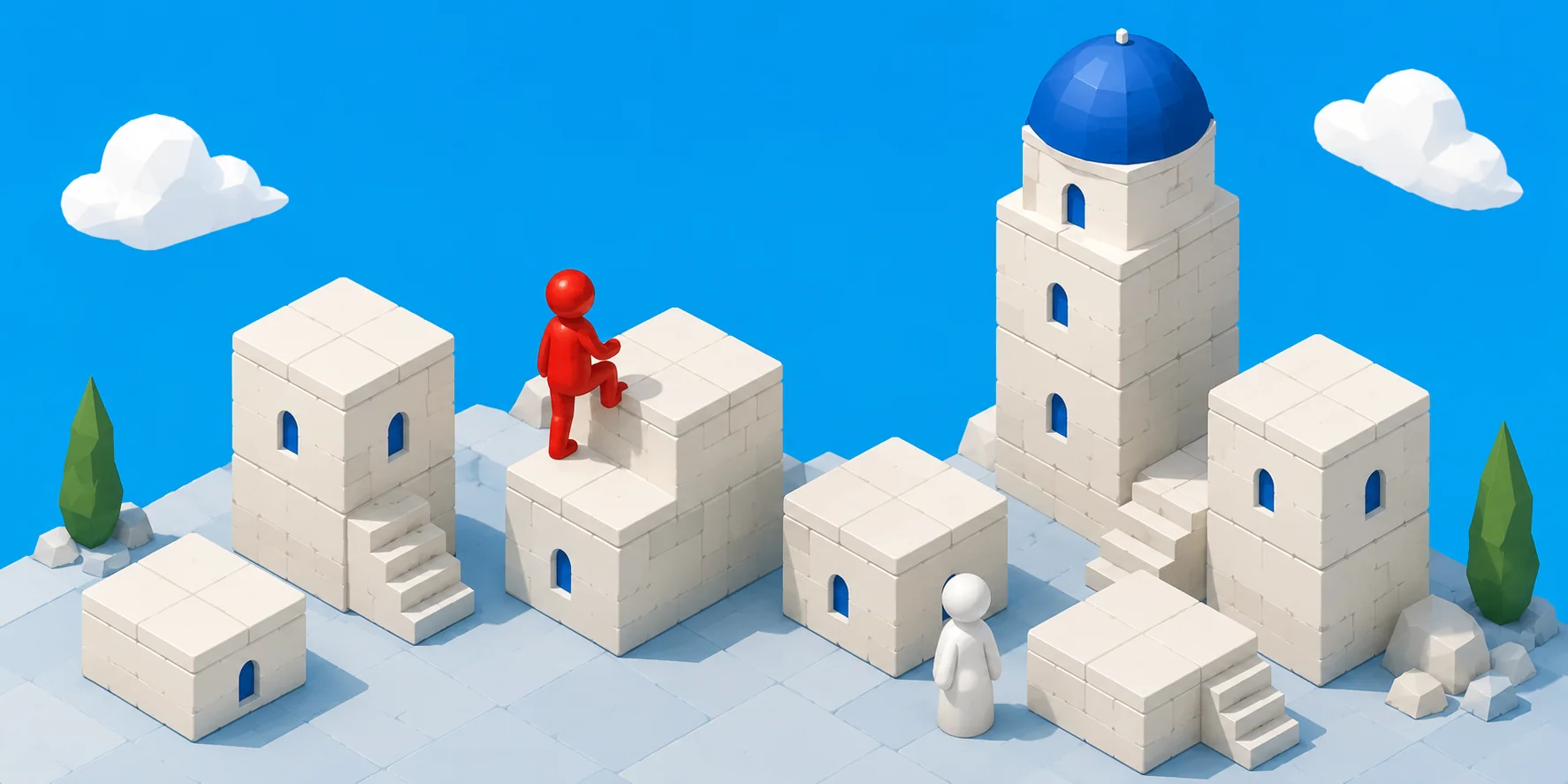
Santorini is a strict-information two-player game with no dice, no cards, and a tiny ruleset. Each player has two workers standing on a 5×5 grid. On every turn you do exactly two things, in order:
- Move one of your workers one square in any of the eight directions (orthogonal or diagonal), as long as the destination is at most one level higher than its current square.
- Build on a square adjacent to that worker — adding a first, second, or third floor, or, if a third floor already exists, a final blue dome that closes the building forever.
You win the moment you step a worker onto a third-floor (level-3) square.
That’s the entire game.
The board
The board is a 5×5 grid — 25 squares. Each square can have at most:
- A first floor (level 1)
- A second floor (level 2, on top of the first)
- A third floor (level 3, on top of the second)
- A dome capping it (no longer enterable by anyone)
Buildings stack: you can only build the next level up. You can’t skip levels. Once a square has a dome, no worker can ever stand on it.
Setting up
Each player chooses two workers (different colours) and places them on any squares of the empty board. Conventionally the first player places one worker, then the second player places one, then alternating until each player has two workers down. The board starts with no buildings.
In Pop Play this is automatic — placement is the first thing you do once the match begins.
The two-step turn, in detail
Step 1 — Move
Pick one of your two workers. Move it to one of the (up to) eight neighbouring squares — N, NE, E, SE, S, SW, W, NW. Restrictions:
- The destination must not already have one of your workers, your opponent’s workers, or a dome.
- The destination’s height must be at most one level higher than your current square. So a worker on level 1 can step up to level 2, but not from level 1 to level 3. A worker can step down any number of levels, including from level 3 down to ground (level 0) — though this is rarely a winning idea.
If you move your worker onto a level-3 square, you immediately win. No build phase. Just stop and grin.
If you can’t legally move with either of your workers — for example, both are completely surrounded by dome-capped squares or out-of-reach high buildings — you lose.
Step 2 — Build
After moving (and assuming you didn’t just win), build adjacent to the worker you just moved. The build square can be any of the (up to) eight neighbours. Restrictions:
- The build square must not contain a worker (yours or your opponent’s).
- The build square must not already have a dome.
- You build the next level the square is missing — so a square with no buildings becomes level 1, a level-1 square becomes level 2, level 2 becomes level 3, and a level-3 square becomes a dome.
You build exactly one piece per turn. Always.
How to win
Three ways:
- Climb a third floor. Move a worker onto a level-3 square. (Most common win.)
- Trap your opponent. If your opponent cannot legally move either worker on their turn — surrounded by domes, blocked by you, or every adjacent square is too high — they lose.
- Stall their build options to inevitability. Same as #2, just reached by building rather than blocking directly.
There’s no point system, no time limit, no draws.
What makes Santorini great
The cleanness. Most strategy games scale rules to add depth. Santorini stays at move-and-build, win-by-stepping-up and finds depth in the spatial geometry of who can reach what level when. A typical match takes 8–15 minutes and never feels like it dragged.
The other thing is the god powers in the full physical version — each player optionally draws a card that overrides one rule (e.g., the Apollo card lets you swap places with an adjacent enemy worker, the Demeter card lets you build twice). Apps usually offer god powers as a toggle. The base game without powers is the cleanest version and what most people start with.
Santorini’s history
Santorini was designed by Dr. Gordon Hamilton, a Canadian mathematician known for his work on math education and game design through MathPickle. Early versions of the game existed years before its wider commercial release, circulated as small self-published print runs.
The current widely-known edition was published by Roxley Games through a successful Kickstarter campaign in 2016. The campaign raised a multi-six-figure total — a notable result for a small abstract strategy game at the time — and turned Santorini from a niche math-puzzle into a modern board-game shelf staple.
The visual identity — clean white cubic Greek-island buildings, blue domes, blue Aegean board — is iconic and has been reproduced widely in digital adaptations. Pop Play’s themed worlds for Santorini lean into Greek and Mediterranean palettes for that reason.
Santorini strategy primer
A few principles that make a real difference:
- Build one floor up and one floor away. A common new-player mistake is building third floors directly under your opponent’s worker — you’ve just handed them a winning step. Always check: would the build I’m about to place let them win?
- Make your opponent’s worker pay rent. Build first floors next to their workers without fully committing — anywhere they can step up to is anywhere you don’t want to commit too high too early.
- Cap their reach. A dome on a level-3 square locks that square out forever. Use this defensively when an enemy worker is one move from stepping up to a 3 you helped build.
- Two workers attack better than one. You always have two. The standard attacking pattern is one worker climbing while the other dome-caps escape routes.
- Track adjacency. Any square that’s adjacent to a level-3 with the right approach height is a win-next-turn square. Count those.
- Don’t ignore the corners. Corner squares have only three neighbours, half what centre squares have. Trapping an opponent in a corner is often easier than mid-board.
Santorini on Pop Play
The Pop Play version uses the base game without god powers (the cleanest game), with smart bot opponents, online multiplayer, and the themed-worlds skin layer. Specifically:
- Bot opponents at multiple difficulty levels.
- Online multiplayer with friends or matchmaking.
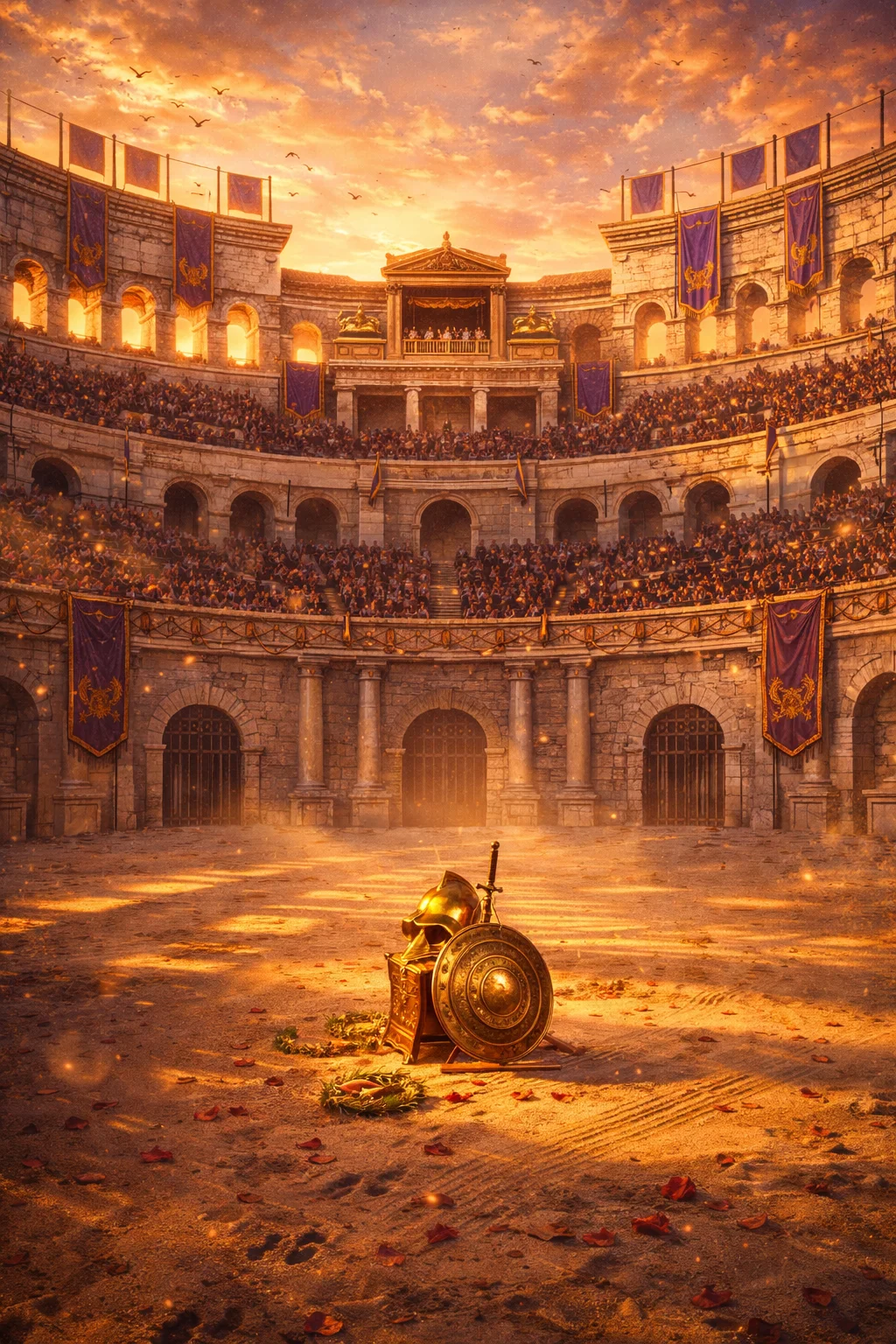
- 51 themed worlds — Greek Olympus and Roman Colosseum are natural fits, but the Floating Islands and Celestial Palace skins also work well for the climbing aesthetic.
- Build / move animation so you can see the height change clearly even on small phone screens.
- Last-move highlight so opponents can see what just happened during fast online matches.
Frequently asked questions
How long is a Santorini game?
Most matches take 8–15 minutes. New players often finish in 5 once one side commits to a climb.
Is Santorini solved?
Not in any meaningful published sense. The game tree is small in principle (5×5 board, two workers per side, finite building heights) but the placement phase plus the move/build branching make a full game-theoretic solution non-trivial.
How many workers does each player have?
Two. Always two. Each turn you move one of them.
Can you win on your first move?
No. The fastest possible win is around turn 5 — you need three floors to exist before anyone can step onto level 3.
What if I can’t move?
You lose. Not being able to move or not being able to build (after a legal move) ends the game in your opponent’s favour.
Are god powers worth using?
The base game is fine and arguably more elegant. God powers add asymmetry and replay variety but require more memorization. Pop Play exposes them as an option once you’ve played a few base-game matches.
Where can I play Santorini on mobile?
Pop Play has it free. The official Roxley digital adaptation also exists with paid expansions; Pop Play’s version is free with no ads.