What is Gomoku?
Gomoku is the simplest possible “alignment” game: take turns placing stones on grid intersections; first to five in an unbroken line wins. There are no captures, no pieces, no movement after placement. Once a stone is placed, it stays.
That simplicity hides the game’s depth. With a 15×15 board and ~225 possible move points, a single Gomoku game has more legal sequences than chess — and unlike chess, every position is decided purely by spatial pattern recognition.
The board and pieces
Gomoku is traditionally played on a Go board — 15×15 or 19×19 grid of lines. Stones are placed on the intersections of the grid lines (not in the squares between).
- Black stones for one player.
- White stones for the other.
Each player has a large supply of stones — effectively unlimited for game purposes (no game ever uses more than ~80 stones per side in practice).
Pop Play uses a 15×15 board, the standard for casual play.
How to win
You win by placing five of your stones in an unbroken line — horizontally, vertically, or diagonally. The line must be exactly five in a row; you can’t break the line with a gap.
In strict Gomoku (free Gomoku), exactly five-in-a-row wins. Six or more in a row also counts as a win in casual play. Some tournament variants — notably Renju — restrict Black’s options because Black (who moves first) has a known advantage; we cover that briefly below.
Setting up
The board starts empty. Black places the first stone, traditionally in the centre intersection. Players then alternate placing one stone per turn. There’s no setup phase, no piece development — first move is into a fully empty board.
In Pop Play this is automatic. On a physical Go board, the only convention is that whoever has black plays first (often the lower-rated player or the loser of the previous match).
A turn
Per turn:
- Pick any empty intersection.
- Place your stone on it.
- Pass the turn.
If your placement creates an unbroken line of five (or more) of your stones, you win immediately.
That’s it. There’s no capture, no movement, no special pieces, no point system.
What makes Gomoku great
Two things:
The first is density of decisions. Every move is a real strategic choice — there are no “tempo” moves you make automatically because the rules force you to. You’re free to play anywhere on the board, which means you must reason about where matters most every single turn.
The second is threat layering. A strong Gomoku move usually creates two threats at once — for example, a “double three” formation that creates two open lines of three stones, each of which can be extended to four. Your opponent can only block one. This makes attacking play incredibly satisfying once you see the patterns.
Gomoku’s history
The game has been played in Japan, Korea, and China for centuries. The exact origin is contested:
- China has a long tradition of alignment games played on Go boards, with proto-five-in-a-row references appearing in Chinese sources dating back many centuries.
- Japan standardised the modern rule set in the 17th and 18th centuries, where the game became known as Gomoku Narabe (五目並べ — “five-stones-in-a-row”).
- Korea plays a near-identical version called Omok (오목).
The game spread globally in the late 20th century through Asian community presence, computer adaptations, and the rise of online play.
A central problem in Gomoku theory is that the first player (Black) has a winning strategy in unrestricted (“free”) Gomoku. This was demonstrated by Victor Allis in his 1990s research — Black wins with optimal play. The result is what motivates Renju’s first-player handicap rules in tournament play.
This led to the development of Renju — a tournament variant of Gomoku that handicaps the first player by forbidding certain Black-only moves (overlines, double-threes, double-fours). Renju is played at a competitive level in Japan, Korea, China, Russia, and several European countries, with ongoing world championships.
For casual play and on Pop Play, the unrestricted “free Gomoku” rule is what you’ll encounter — both players have the same options. Renju is a separate competitive scene.
Gomoku strategy primer
Patterns matter more than positions. Internalise these:
Open vs. closed threats
A threat is “open” if both ends of a line are still empty, “closed” if one end is blocked by an opponent stone or the edge of the board. Open threats are dangerous; closed threats are easy to handle.
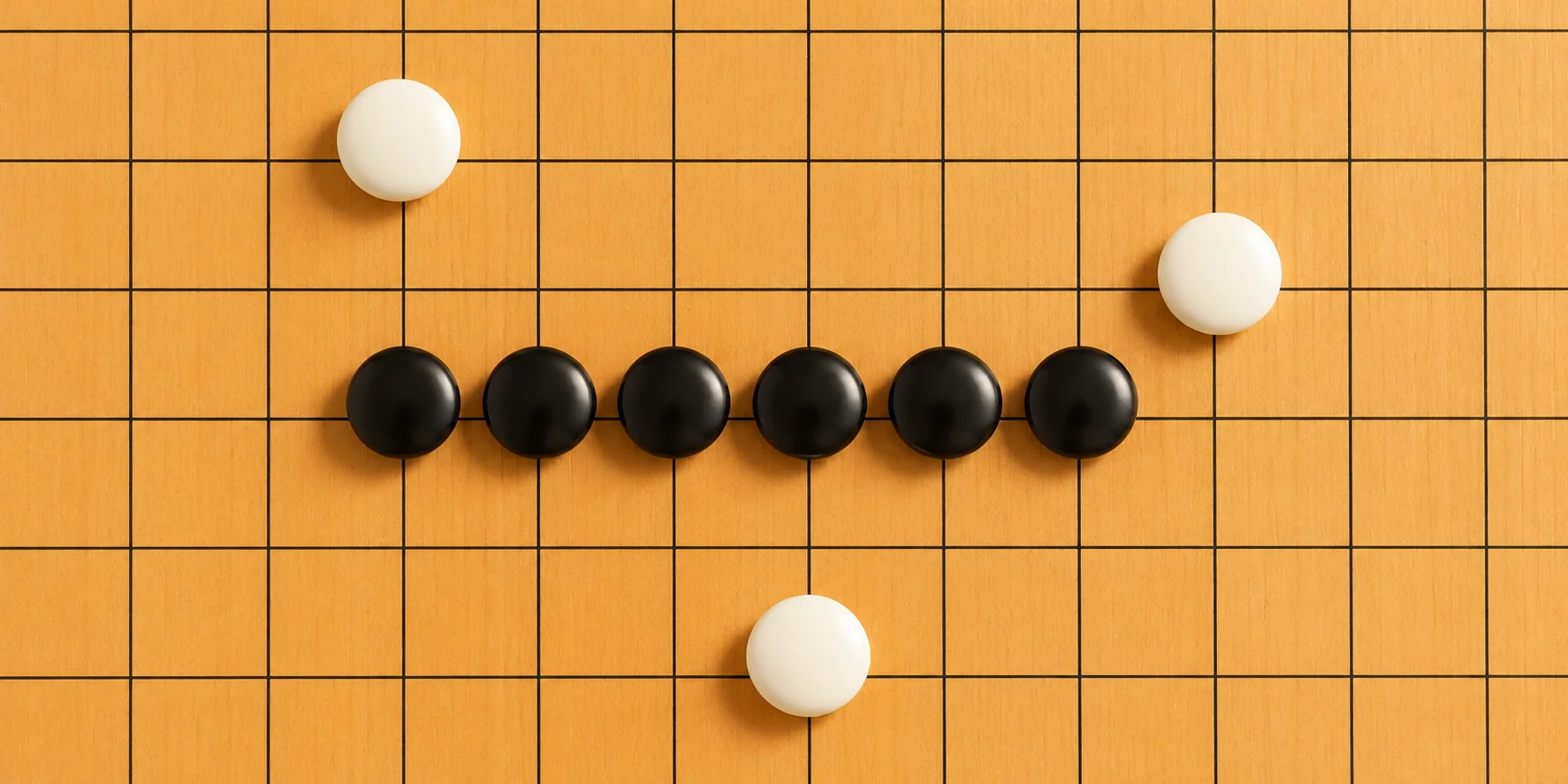
- Open three: three of your stones in a row with empty intersections on both ends. Your opponent must block one end immediately or you’ll make four-in-a-row next turn.
- Open four: four of your stones in a row with empty on both ends. Game-ending — you win on your next turn no matter how they respond.
- Closed four: four in a row with one end blocked. Still a threat — they have to block the open end immediately.
Double threats
The cleanest winning moves create two threats with one stone:
- Double three — a stone that creates two open-three lines simultaneously. Opponent can only block one, you win.
- Double four — a stone that creates two open-four threats. Opponent has no defence.
- Three-four combination — sometimes the strongest move, especially if the four threat is hard to block.
Recognising these patterns from sight is what separates intermediate from advanced players.
Defensive thinking
Always check: can my opponent’s next move create a threat I can’t block? If yes, I need to block now or interrupt with a stronger threat.
Centre play
The centre of the board has the most diagonal lines passing through it (8 lines vs. 5 at the edges, 3 at the corners). Open with a centre stone and pressure the centre throughout.
Gomoku on Pop Play
Pop Play uses the standard 15×15 free-Gomoku rules — both players have full freedom, first to five wins. Specifically:
- Smart bot opponents at multiple difficulty levels — the hard AI uses pattern-recognition heuristics and can punish loose play hard.
- Online multiplayer with friends or matchmaking.
- Themed worlds — Jade Court, Cherry Blossom Garden, Bamboo Forest, and Samurai Temple are all natural fits given the game’s East Asian heritage.
- Last-move highlight + capture-of-the-eye pattern previews so threats are easy to read on small phone screens.
Frequently asked questions
Is Gomoku solved?
Yes — for unrestricted free Gomoku on a 15×15 board, Victor Allis showed that Black (first player) wins with optimal play. This is what motivates Renju, the tournament variant that handicaps Black to balance the game.
How long is a Gomoku game?
Most casual matches finish in 5–15 minutes. Strong players can win in 8–15 moves; tense matches between equals can run 30+ moves.
What’s the difference between Gomoku and Five-in-a-Row?
They’re the same game. “Five-in-a-Row” is the English literal translation of the Japanese name. “Gobang”, “Omok”, and “Caro” are regional variants of essentially the same rules.
What’s Renju?
A tournament variant of Gomoku where the first player (Black) is forbidden from making certain moves (overlines, double-threes, double-fours) to balance the first-move advantage. Casual Gomoku doesn’t use these restrictions.
What’s the best opening move?
Centre. Playing in the middle of the board maximises the lines that intersect at your stone. Starting near a corner is a known weak opening.
Is Gomoku harder than tic-tac-toe?
Yes — vastly. Tic-tac-toe is solved (always a draw with optimal play). Gomoku has a much larger state space and richer pattern grammar despite the simple rule.
Where can I play Gomoku on mobile?
Pop Play has it free. Several Gomoku-specific apps exist on iOS and Android with varying quality; Pop Play’s version is free with no ads.