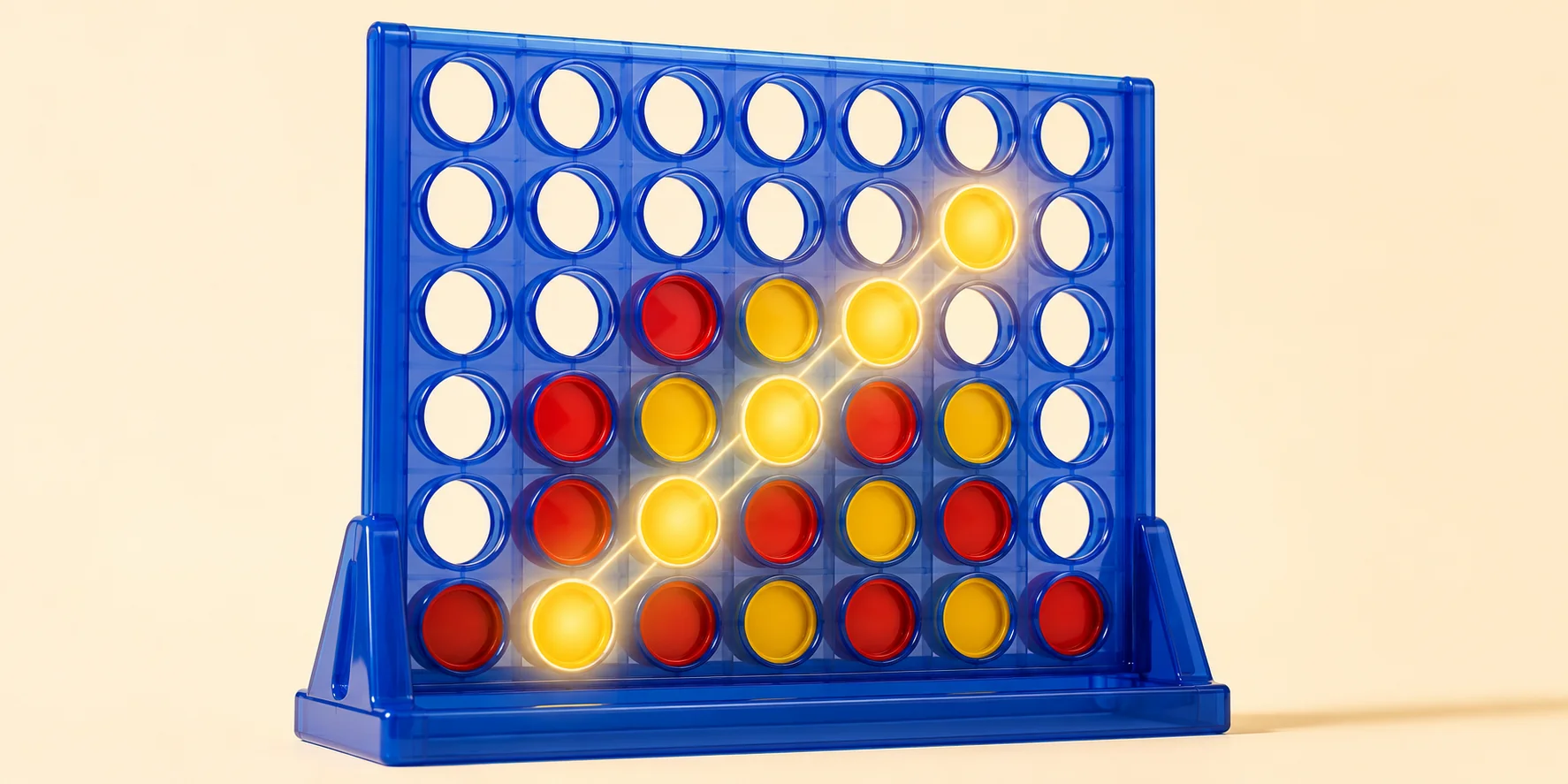
What is Connect 4?
Connect 4 is a vertical-drop tile-alignment game. Two players take turns dropping discs of their colour (typically red and yellow) into one of seven columns. Discs fall to the lowest empty slot in that column. The goal is to make four of your discs in a row — horizontally, vertically, or diagonally.
It’s brilliantly simple: the rules can be taught in 30 seconds, but strong play involves multi-move planning, threat layering, and what mathematicians call “zugzwang” — being forced into a losing move because all alternatives are worse.
In Pop Play the game is called Join 4 (the catalog slug is join4) — same game, slightly different name to differentiate from the trademarked “Connect 4” name owned by Hasbro.
How to win
Make four of your discs in a row anywhere on the board:
- Horizontal: four in a row across one of the six rows.
- Vertical: four stacked in one of the seven columns.
- Diagonal: four in a diagonal line — either rising or falling.
If the board fills completely without anyone making four-in-a-row, the game is a draw.
Setup
The board is a vertical grid: 7 columns wide and 6 rows tall. The board starts empty. Each player has an effectively unlimited supply of discs of their colour.
Decide who plays first. Tradition: red goes first, yellow second.
A turn
On your turn:
- Pick any of the 7 columns.
- Drop one of your discs into the top of that column.
- The disc falls to the lowest empty slot in that column due to gravity.
- If your disc completes four-in-a-row, you win immediately.
- Otherwise the turn passes to your opponent.
You cannot play in a full column. If all columns are full and no four-in-a-row exists, the game ends in a draw (rare but possible).
A worked example
Imagine the board after a few moves:
. . . . . . .
. . . . . . .
. . . . . . .
. . . . . . .
. . . R . . .
. . Y R Y . .
(R = Red, Y = Yellow. Bottom row is row 1, leftmost column is col A.)
Red plays column D. Disc falls to row 3 (above row 2’s R):
. . . . . . .
. . . . . . .
. . . . . . .
. . . R . . .
. . . R . . .
. . Y R Y . .
Red now threatens vertical four-in-a-row if they play column D twice more. Yellow must block by playing column D themselves on their next turn — even though they’d rather develop elsewhere.
That’s a “forced move” — Yellow’s hand is forced by Red’s threat. Building chains of forced moves is core Connect 4 strategy.
What makes Connect 4 great
Three things:
-
Speed of mastery. Pure beginners can play meaningfully within minutes. Intermediate players build measurable skill within 10-20 games. Strong players develop tactical intuition within months. The skill curve is unusually well-paced.
-
Threat density. A typical Connect 4 board has 60+ possible four-in-a-row lines passing through it. Every disc you play affects multiple lines. The game forces you to evaluate moves multi-line.
-
Math-backed depth. Unlike Tic Tac Toe (which is solved as a draw) and unlike chess (which is too large to solve), Connect 4 is completely solved — but the solution is non-obvious. First player wins with optimal play, but the path to that win requires playing in the centre column on turn 1 and continuing with very specific responses. Most casual players, even strong ones, don’t follow the optimal line.
Connect 4’s history
Connect 4 was published by Milton Bradley (now part of Hasbro) in 1974. The design is credited to Howard Wexler and Ned Strongin, with Wexler holding the credit for the iconic vertical-grid plastic frame that gave the game its tactile, toy-shelf identity.
Connect 4 became one of the best-selling family games of the late 20th century, with global sales in the multi-millions of units. Its accessibility — the rules can be learned by a 5-year-old, but it’s also genuinely strategic for adults — made it a fixture in living rooms, schools, and game boxes worldwide.
The mathematical history is just as interesting:
- In 1988, the game was independently solved by both James D. Allen and Victor Allis (whose master’s thesis remains a frequently-cited reference). Both proofs concluded that Connect 4 is a first-player win under optimal play.
- The optimal first move is the centre column (column D in our notation). Any other first move gives the second player at least a draw, and often a win for the second player.
- The full game tree has been computed; modern computers can solve any Connect 4 position from any state in milliseconds.
This makes Connect 4 one of the most rigorously analysed family games in board-game history.
Connect 4 strategy primer
Even casual play improves dramatically with these:
1. Take the centre column first
If you play first, drop your first disc in the centre column. The centre column is part of more potential four-in-a-row lines than any other — 13 lines pass through the centre column vs. 7-9 for outer columns. Playing centre maximises your future options and limits your opponent’s.
2. Block 3-in-a-rows immediately
If your opponent has three discs in a row with an open square at one end (or both), they’re one move from winning. Block immediately — even if you have to give up a developing move on your side.
3. Watch for “double threats”
A move that creates two unblockable three-in-a-row threats simultaneously is almost always game-winning. Common patterns:
- A row of three in the middle of the board with open squares on both ends.
- Two intersecting diagonals where one move completes both threats.
4. Stack vertically when ahead
Vertical four-in-a-rows are the easiest to set up because columns fill bottom-up. If you’re already two-in-a-row in a column, your opponent has to play in that column on the very next turn or you win — that wastes their turn.
5. Odd vs. even threats
This is advanced but genuinely game-defining. The rows of the board are numbered 1-6 from the bottom. As Connect 4 fills up, the parity of which rows you’re playing into matters:
- The first player’s threats in odd rows (1, 3, 5) tend to be reachable in late-game zugzwang positions.
- The second player’s threats in even rows (2, 4, 6) tend to be the targets.
Strong play involves setting up threats in your “winning” parity rows and blocking your opponent’s.
This is why centre-column play is so strong for the first player — it sets up odd-row threats early.
Connect 4 / Join 4 on Pop Play
Pop Play’s version is a faithful 7×6 Connect 4 implementation. Specifically:
- Smart bot opponents at multiple difficulty levels — the hard AI plays close to optimal and is genuinely difficult to beat.
- Online multiplayer with friends or matchmaking.
- Themed worlds — Neon Cyberpunk, Candy Kingdom, Crystal Cavern, and Alien Planet skins re-skin the disc and grid art for every world.
- Last-move highlight + win-line animation when the four-in-a-row is found.
Frequently asked questions
Is Connect 4 solved?
Yes. Solved independently in 1988 by James D. Allen and Victor Allis. First player wins with optimal play, starting with the centre column. The full game tree has been computed.
Can the second player ever win?
Yes — if the first player plays sub-optimally (e.g., starts in any column other than centre), the second player can force at least a draw, and against weaker first-player choices can force a win.
How long is a Connect 4 game?
Most casual matches finish in 3-7 minutes. Strong-vs-strong matches can finish in 4-5 moves (rare collapses) or fill most of the 42-cell board (15-20 moves total).
How big is the Connect 4 board?
7 columns × 6 rows = 42 cells. Standard. Variant boards (8×7, 9×7) exist but are rarely used.
What’s the optimal first move?
Centre column. Always. Any other first move loses (or draws) to optimal play.
What’s the difference between Connect 4 and Join 4?
Same game, different name. Connect 4 is Hasbro’s trademark; Join 4 is Pop Play’s non-trademarked name for the same mechanic. The slug join4 is canonical inside the app.
Where can I play Connect 4 on mobile?
Pop Play has it free as Join 4. Multiple Connect-4-style apps exist; Pop Play’s version is free without ads and includes 13 other games.