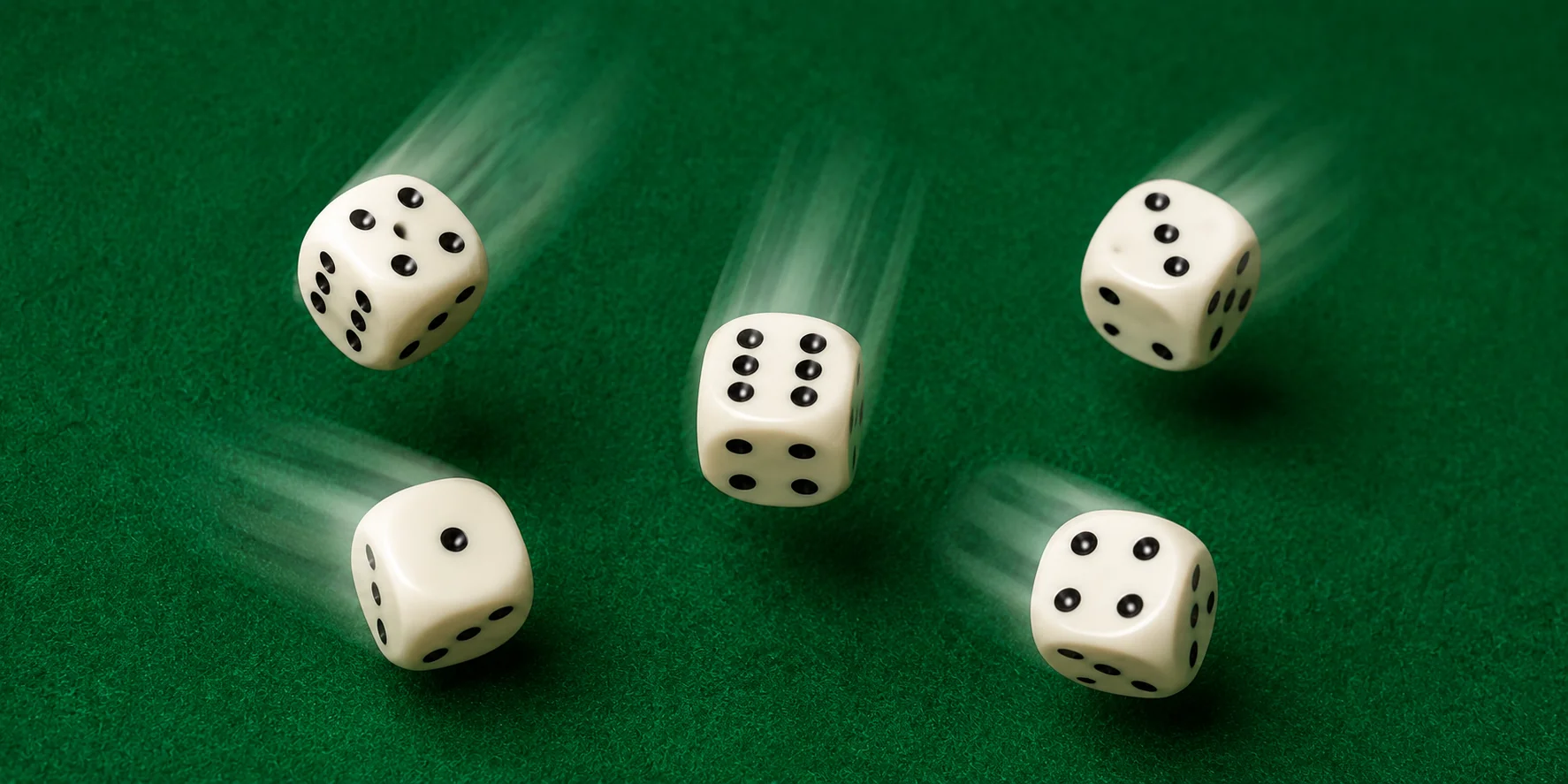
What is Greedy Dice?
Greedy Dice — known by its more common name Pig in dice-game circles — is a quintessential press-your-luck game. It’s played with just one die (in basic Pig) or two dice (in some variants). Each player takes a turn that consists of repeated rolls:
- Each non-1 roll adds to your turn’s running total.
- Rolling a 1 resets your turn’s running total to zero and ends your turn.
- You can stop anytime before rolling to add your turn’s running total to your bank.
First player to reach a target score (typically 100) wins.
The game’s elegance is in the constant decision: keep rolling for more points, or stop and bank what you have? It’s a simple game with surprisingly deep mathematical properties.
How to win
Be the first to bank a total score equal to or exceeding the target (typically 100 points).
Some variants use 50 points (faster), 200 points (slower), or play to a fixed number of rounds with the high banker winning.
Pop Play uses 100 points as the standard target.
How a turn works
On your turn, do this in a loop:
- Roll the die.
- If the result is 2-6, add it to your turn’s running total.
- If the result is 1, your turn’s running total goes to zero and your turn ends. Pass the dice.
- After rolling 2-6, you decide: roll again, or stop?
- If you stop, add your turn’s running total to your bank (your overall score). Pass the dice.
- If you continue, go back to step 1.
You can stop after any non-1 roll. You don’t have to stop at any particular point — the choice is yours every roll.
A worked example
You start the round with 23 banked points. Target is 100.
- Roll 4 → turn total = 4. Continue?
- Roll 5 → turn total = 9. Continue?
- Roll 3 → turn total = 12. Continue?
- Roll 6 → turn total = 18. Continue or stop?
You stop. Bank: 23 + 18 = 41. Pass dice.
Or — you continue:
- Roll 1 → bust. Turn total → 0. Bank stays at 23. Pass dice.
That dilemma — push for more, risk losing it all — is the entire game.
What makes Greedy Dice so addictive
The game has a perfect tension structure:
- Each roll is a self-contained risk. You always know exactly what you stand to gain and lose.
- The expected value calculation is simple but psychologically hard. Mathematically there’s an optimal stopping strategy, but in the moment, “just one more” feels right.
- Comebacks are constant. A losing player can win in a single hot streak. A leading player can’t lock in a win without continuing to risk.
- It’s fast. A turn averages 3-6 rolls. A complete game finishes in 5-10 minutes for two players.
Greedy Dice / Pig’s history
Pig is an old game — older than its modern documentation. Dice games with press-your-luck mechanics appear in many cultures dating back at least to ancient Greece, and similar mechanics show up in medieval European gambling games and various Asian dice traditions.
The specific name “Pig” and the canonical 1-die / score-to-100 ruleset is generally attributed to 20th-century American parlor-game and gambling traditions, with the standardised rules entering wide circulation through mid-century game-rule compendia.
The game has been mathematically studied extensively. The most famous analysis is by Todd W. Neller and Clifton G.M. Presser, who published “Optimal Play of the Dice Game Pig” in 2004. Their result: the optimal strategy depends on both your score and your opponent’s score. As a rough approximation:
- Roll until you’ve accumulated 20 points in your current turn, then stop. (This is the simple “always stop at 20” heuristic that’s slightly suboptimal but very close to optimal.)
- The fully optimal strategy varies depending on how close you and your opponent are to 100 — when behind, push harder; when ahead, bank conservatively.
The expected value of one roll in Pig is straightforward. With your current turn total x:
E(roll) = (1/6) × (-x)             # the bust case (rolling a 1)
        + (1/6) × (2 + 3 + 4 + 5 + 6)  # the non-bust cases
        = (20 - x) / 6
When x ≥ 20, the expected value of continuing is non-positive — so stopping is mathematically correct. That’s where the “stop at 20” heuristic comes from.
Modern variants include:
- Pig Two-Dice: Rolls two dice; rolling any 1 ends turn (if both 1s, lose your bank). Faster pace, harder variance.
- Hog: Roll multiple dice at once and lose all if any 1.
- Big Pig: Push the bank also at risk.
- Pass the Pig: A commercial variant using small pig figurines as the “dice” — sold by Hasbro since 1977. The pigs land in different positions giving different point values.
Pop Play uses the standard one-die Pig with the stop-at-any-point rule.
Greedy Dice strategy primer
The math is more interesting than most gamblers realise:
1. The 20-point heuristic
Stop when your turn total reaches 20 or higher. This is mathematically near-optimal across most game positions and is the easy rule of thumb.
2. Behind = push harder
If you’re significantly behind (e.g., you have 30 points and your opponent has 80), you can’t win with conservative banking. You need to risk more to catch up — the expected value of continuing past 20 is positive when the alternative is losing the game.
3. Ahead = play conservatively
If you’re at 80 points and your opponent at 30, every banked point gets you closer to winning. Bank smaller turn totals (10-15 points) to lock in your lead with minimal risk.
4. Endgame: target the win
Once your bank + turn total reaches the target (100), you’ve won as soon as you bank. So if you’re at 90 banked and you’ve accumulated 10 in your turn — stop immediately. The remaining game is irrelevant.
5. Don’t anchor on opponent’s last turn
Every turn is independent. Just because your opponent just rolled a 1 (busting their turn) doesn’t mean you should push more aggressively. The dice don’t remember.
Greedy Dice on Pop Play
Pop Play’s Greedy Dice uses standard one-die Pig with target 100. Specifically:
- Smart bot opponents at multiple difficulty levels — the hard AI plays close to mathematically optimal, with adjustment for relative score.
- Online multiplayer — 1v1 with friends or matchmaking.
- Themed worlds — Lava Kingdom, Pirate Cove, Dragon Lair, and Arabian Nights skins suit the risk-and-reward feel.
- Animated dice rolls + running tally so you can see your turn total accumulate clearly.
Frequently asked questions
What’s the difference between Pig and Greedy Dice?
Same game. “Pig” is the traditional dice-game name; “Greedy Dice” is Pop Play’s branding. The mechanics are identical: roll for points, lose all on a 1, bank when you stop.
What’s the optimal strategy?
Roughly: stop when your turn total reaches 20. Adjust for game position — push harder when behind, more conservative when ahead.
How long is a Greedy Dice game?
Most games finish in 5-10 minutes for two players.
Is the target always 100?
100 is the most common target. Some variants use 50 (faster) or 200 (longer). Pop Play uses 100.
Does the order players take turns matter?
Slightly. Computer analysis of optimal play shows a small first-player advantage, with the first player winning slightly more than half the time. The exact ratio depends on small variations in the optimal strategy used; the effect is modest in casual play.
Why is rolling a 1 so harsh?
That’s the entire game. The asymmetric penalty (losing your turn total vs gaining 2-6 per roll) creates the tension that makes the game fun. Without the harsh penalty, players would just roll forever and the game would be trivial.
Where can I play Pig / Greedy Dice on mobile?
Pop Play has it free. Several Pig dice apps exist on iOS and Android; Pop Play’s version is free with no ads and includes 13 other games.