What is Checkers?
Checkers is a two-player strategy game played on an 8×8 chequered board, with each player starting with 12 pieces of one colour (typically red and black, or white and black). Pieces move diagonally forward, capture opponents by jumping over them, and “promote” to kings when reaching the far row.
The game is one of the most globally widespread board games, with regional variants — American/English, International, Russian, Brazilian, Turkish — that share the basic structure but vary in exact rules.
The variant most people know in English-speaking countries (including the version on Pop Play) is American Checkers, also called English Draughts. We’ll cover that as the standard, then briefly note the major variant differences.
How to win
You win by either:
- Capturing all your opponent’s pieces.
- Blocking your opponent so they cannot move any of their remaining pieces.
If neither condition occurs and play stalls (e.g., both players have a single piece each in defensive positions), the game is declared a draw — typically after 40 moves with no captures.
Setup
The board has 64 squares — 32 light and 32 dark — but pieces only ever play on the dark squares. The board is oriented so each player has a dark square in their bottom-left corner.
Each player places 12 pieces on the dark squares of the three rows closest to them. The middle two rows are empty at the start.
Standard convention: black moves first (or “the darker colour” — Pop Play follows this).
Movement rules
Regular pieces (“men”)
A regular piece moves diagonally forward by one square to an empty dark square. Forward means toward the opponent’s side of the board.
Captures (jumps)
If an opponent piece is diagonally adjacent to one of your pieces, AND the square directly beyond that piece is empty, you can capture by jumping over the opponent’s piece into the empty square. The captured piece is removed from the board.
Captures are mandatory in standard American Checkers. If you have a capture available, you must take it. If you have multiple captures available, you must choose one of them — but you can choose which one.
Multi-jumps
If after a jump your piece is in a position where it can immediately capture another opponent piece, you must continue jumping. Multi-jump chains can capture 3, 4, or even 5 pieces in a single turn — game-winning when they happen.
Kings (crowned pieces)
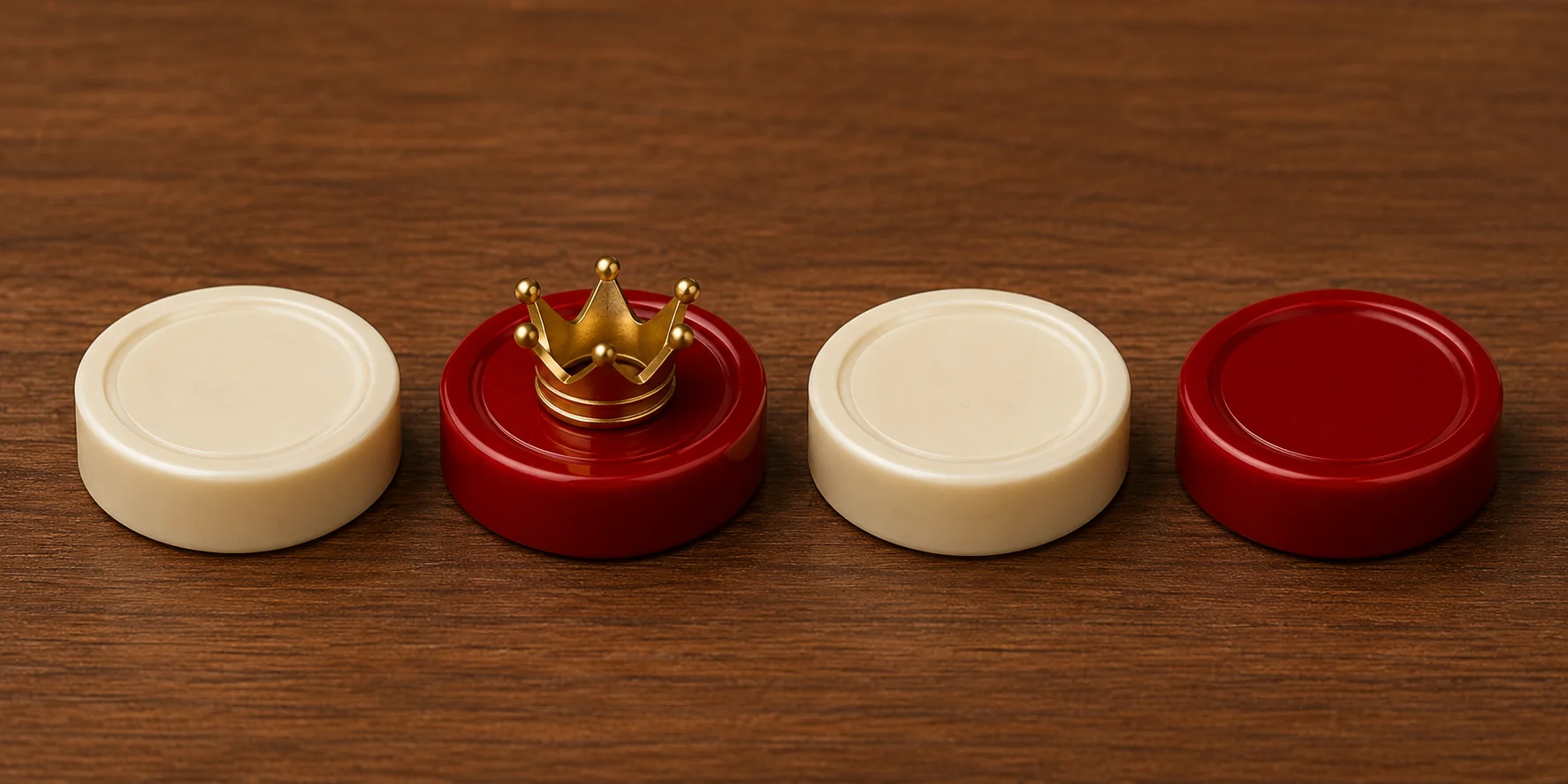
When your piece reaches the back row of the opponent’s side of the board, it gets “crowned” and becomes a king. Kings move and capture in all four diagonal directions — forward and backward.
A king typically lasts longer and dominates the endgame because it has more options.
A worked example
Black’s piece on D6 captures White’s piece on E5 by jumping to F4:
Before:                After:
. . . . . . . .       . . . . . . . .
. . . B . . . .       . . . . . . . .
. . . . W . . .       . . . . . . . .
. . . . . . . .       . . . . . B . .
. . . . . . . .       . . . . . . . .
Now check: from F4, can Black multi-jump? If White has another piece diagonally at E3 or G3 with an empty square beyond, Black continues jumping. Otherwise, the turn ends.
What makes Checkers great
Three things:
-
Speed of mastery. Children learn the rules in 2 minutes. Casual play is enjoyable from the very first game. Strategy starts emerging within 5-10 games.
-
Forced captures. The mandatory-capture rule means every threat must be evaluated immediately. You can’t “ignore” a position — if a capture exists, it happens. This eliminates passive play and forces tactical commitment.
-
King endgames. The transition from material-heavy mid-game to king-heavy endgame is one of the cleanest game-state shifts in any board game. Strong endgame play with kings is its own subgenre of mastery.
Checkers’ history
The game’s roots are very old:
- Alquerque, an ancient game with similar capture-by-jumping mechanics, has roots in the ancient Near East and Egypt; archaeological finds of board-game pieces from the region span thousands of years, with Alquerque-style boards documented across many of them.
- The game spread to Spain via Moorish conquest in the 8th century CE and adapted to a chess-style 8×8 board around the 12th century.
- The modern mandatory-capture rule appears to have been added in France in the early 1500s, making the game “Jeu Forcé” — the version that’s evolved into modern American Checkers.
- English Draughts standardised the modern American Checkers rules in the 18th century.
Variants emerged regionally:
- International Draughts (10×10 board, 20 pieces per side, kings can move long distances) — dominant in continental Europe and former French colonies.
- Russian Draughts (8×8, but men can capture backwards) — popular in Russia and Eastern Europe.
- Brazilian, Turkish, Italian — each with small mechanical differences.
The most famous moment in Checkers history is the 2007 perfect-play solve by Jonathan Schaeffer and the team behind the program Chinook. After roughly two decades of computation, Schaeffer’s team proved that American Checkers is a draw with perfect play from both sides. It was the largest game solved at the time, with a state space on the order of 10^20 positions.
The Chinook program had previously become the first computer to win a human world championship in any game (1994 vs. Marion Tinsley, who had been world champion for 40 years).
Checkers strategy primer
A few principles that immediately improve casual play:
1. Control the centre
Centre squares give pieces the most diagonal options. Push your pieces toward the centre rows in the early game.
2. Don’t push too far too soon
Pieces advanced past the middle of the board can’t retreat (they’re not yet kings). Advancing aggressively without support exposes them to capture.
3. Keep your back row
Your back row prevents opponent kings. Lose your back row and your opponent’s pieces start crowning easily.
4. Build pyramid formations
Two pieces supporting each other (a “buttress”) is much harder to capture than a single piece. Move pieces in mutually-supportive groups.
5. The exchange principle
Sometimes you must take a capture that leads to being captured. The trick is making sure the resulting exchange leaves you with better-positioned pieces or extra material.
6. King hunt
Once a king is on the board, it’s a long-distance threat. Use kings to attack pieces that can’t retreat. Avoid creating positions where your single king must defend multiple men.
Checkers on Pop Play
Pop Play uses American Checkers / English Draughts rules:
- 8×8 board, 12 pieces per side.
- Diagonal forward movement only for regular pieces.
- Mandatory captures (you must take a capture if available).
- Crowning at the opposite back row.
- Kings move and capture in all four diagonals.
Specifically:
- Smart bot opponents at multiple difficulty levels — the hard AI plays at near-Chinook level.
- Online multiplayer with friends or matchmaking.
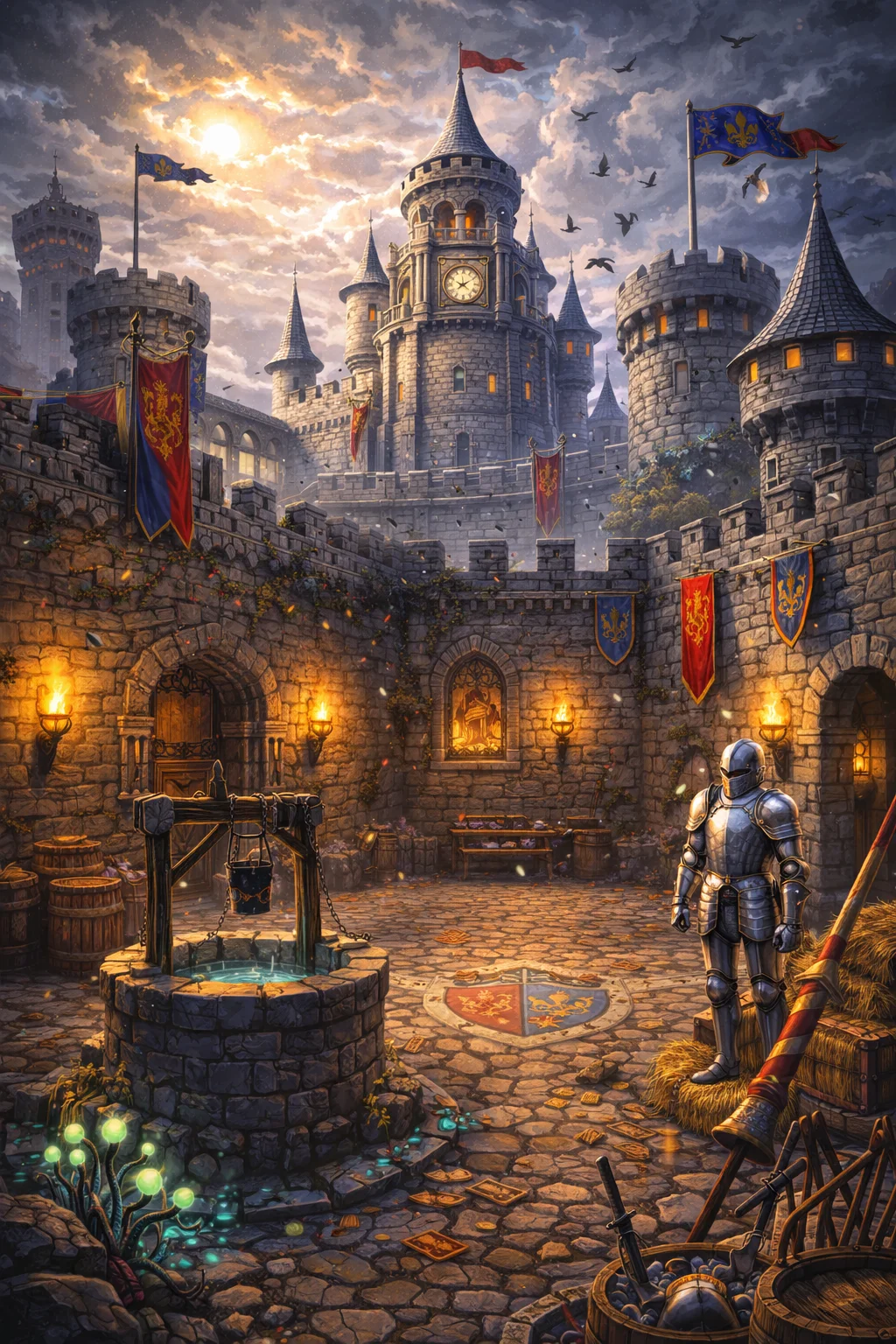
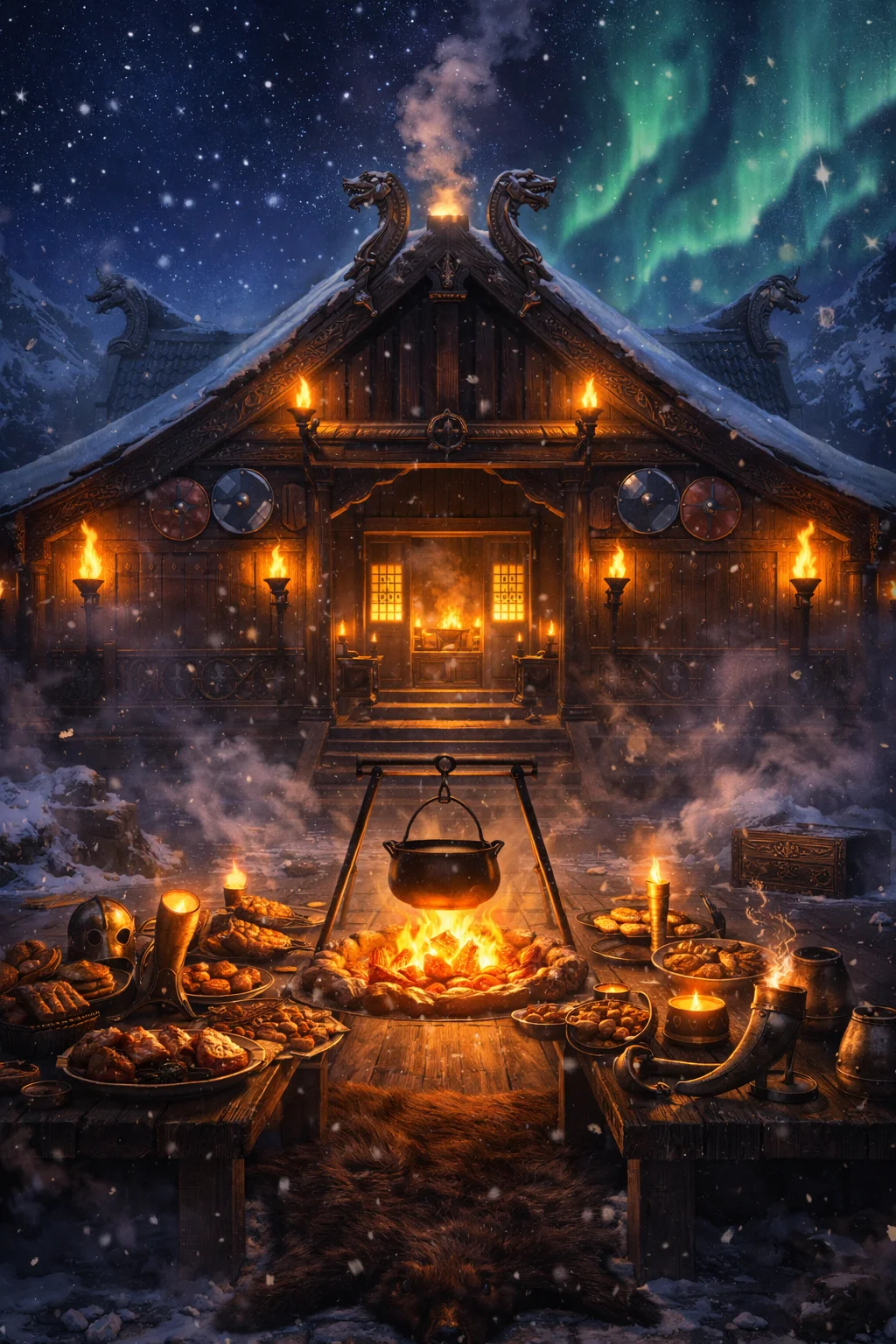
- Themed worlds — Medieval Castle, Viking Longhouse, Pirate Cove, and Frozen Tundra suit Checkers’ classic, rustic feel.
- Capture animation + multi-jump arrow so chains are easy to read.
Frequently asked questions
What’s the difference between Checkers and Draughts?
Same game family, different regional names. “Checkers” is American/Canadian; “Draughts” is British/Commonwealth. The 8×8 American/English Draughts rule set is what’s most commonly meant. International Draughts uses a 10×10 board and is a different game variant.
Are captures mandatory?
In American/English Draughts and Pop Play: yes. If a capture is available, you must take it. If multiple captures are available, you choose which one — but you can’t simply ignore them.
Can pieces move backwards?
Regular pieces (men) cannot. Crowned pieces (kings) can move and capture in all four diagonal directions, including backward.
How does crowning work?
When your piece reaches the back row of the opponent’s side, it’s immediately crowned (becomes a king). A second piece is placed on top of it (or it’s flipped over) to indicate king status. Kings move both forward and backward.
Is Checkers solved?
Yes — Jonathan Schaeffer and the Chinook team solved American Checkers in 2007. Optimal play by both sides leads to a draw.
How long is a Checkers game?
Most casual matches finish in 15-25 minutes. Tight endgame matches between equal players can run 30-40 minutes.
Where can I play Checkers on mobile?
Pop Play has it free. Many Checkers and Draughts apps exist on iOS and Android with various ad densities; Pop Play’s version is free with no ads.