What is Dominoes?
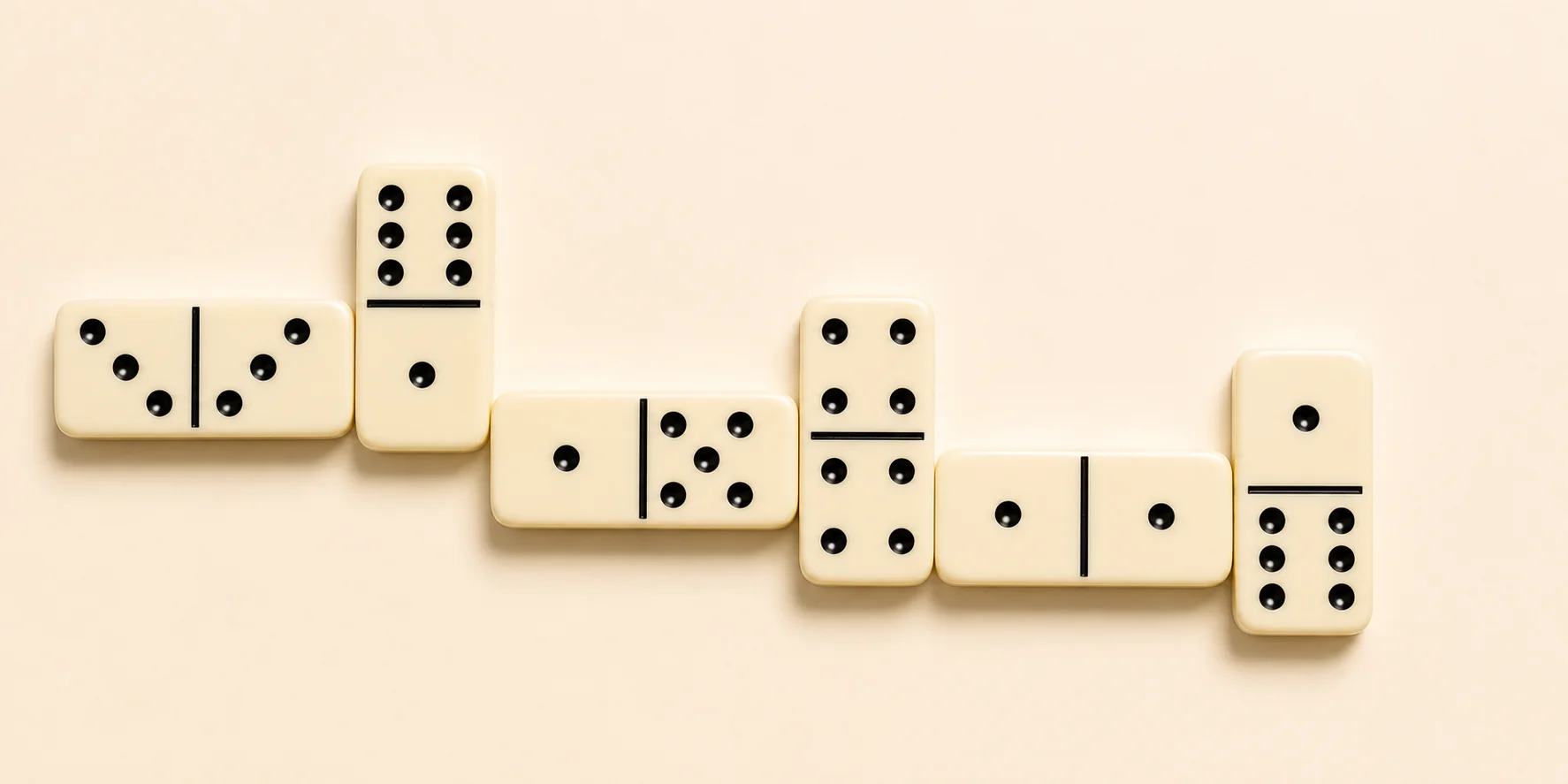
Dominoes is a tile-matching game played with rectangular tiles divided into two halves, each half marked with 0-6 dots (called “pips” or “spots”). A standard “double-six” set has 28 tiles representing every combination of pip values from 0|0 (the “blank”) to 6|6 (the “double-six”).
Two or more players draw tiles into their hands and take turns laying tiles end-to-end on the table, with each newly-played tile’s pip count matching the open end of the chain. First player to empty their hand wins the round.
There are dozens of variants — Block, Draw, Mexican Train, Cuban, Muggins, Bergen, Chicken Foot — that share the matching mechanic but differ on scoring, hand size, and special rules.
Pop Play uses Block Dominoes — the most universally recognised competitive variant.
How to win
In Block Dominoes:
-
Round: First player to play all their tiles wins the round. If both players are stuck (no legal moves) and no one has emptied their hand, the player with the lowest pip count remaining in their hand wins.
-
Game: First player to reach a target score (typically 100 or 150 points) wins the overall game. After each round, the round-winner scores points equal to the sum of pips in the loser’s hand.
In Pop Play the default game ends at 100 points; both rules apply.
Setup
Use a standard double-six set: 28 tiles.
- Shuffle face-down.
- Each player draws 7 tiles (2-player) or 5 tiles (3-4 player) into their hand.
- Remaining tiles form the boneyard (drawn from in some variants; in Block Dominoes you can’t draw from it during play).
- The player with the highest double (typically 6|6) plays first by laying that tile in the centre. If no one has the 6|6, the next-highest double (5|5, 4|4, etc.) plays.
In Pop Play this is automatic.
A turn
On your turn:
- Look at the chain on the table. It has two open ends — the leftmost and rightmost tiles each show a pip count on their open side.
- Find a tile in your hand where one end matches one of the open chain ends.
- Place that tile so the matching ends touch. Your tile now extends the chain on that end.
If your tile is a double (both halves the same value, e.g., 4|4), it’s typically placed perpendicular to the chain (T-junction) for visual clarity. Doubles still match on either of their ends.
If you cannot legally play any of your tiles (none match either open end), you must pass in Block Dominoes (in Draw variants you’d draw from the boneyard until you can play, but Block forbids this).
If both players pass consecutively, the round ends and is scored by lowest-hand-pip-count.
A worked example
Say the chain on the table reads:
[5|3] - [3|2] - [2|6]Open ends: 5 (left) and 6 (right).
Your hand: [1|4], [6|3], [5|5].
[6|3]— yes, the 6 matches the right open end. Play it on the right: chain becomes[5|3]-[3|2]-[2|6]-[6|3]. New open ends: 5 (left), 3 (right).[5|5]— also legal. The 5 matches the left open end. Play it on the left.[1|4]— neither end matches. Can’t play it now.
You’d pick whichever play you think is best — usually the one that empties the higher-pip tiles first, or the one that closes off your opponent’s options.
What makes Dominoes great
Three things:
-
Long social arc. Dominoes matches play out across multiple rounds — typically 5-12 rounds to reach the target score. This lets you read your opponent’s tendencies and strategy over time.
-
Hidden information. Unlike chess or Reversi, you don’t know what tiles your opponent holds. Inferring their hand from what they play (and what they refuse to play) is the heart of strong Dominoes.
-
Visceral satisfaction of chains. Watching a long winding chain develop on the table, with each tile clicking into place, is uniquely satisfying. The physical version is iconic; the digital version preserves the feel through sound and animation.
Dominoes’ history
The game’s roots go back to medieval China. Early Chinese dominoes were tile-based dice games used in gambling halls; Chinese sets traditionally had 32 tiles representing all combinations of two dice, including doubles — a different set composition from the modern Western double-six.
The game arrived in Europe via Italy in the early 18th century — most likely brought by Venetian merchants from the Far East. The Italian version simplified the Chinese rules and adopted the double-six set composition (28 tiles). From Italy the game spread rapidly through France, Spain, and England.
The name “domino” is generally attributed to the French domino — a hooded cloak worn by Catholic priests. The cloak’s black exterior with white interior visually echoed the original European tile design of black wood with ivory pips.
The game spread to the Caribbean and Latin America through European colonisation in the 18th-19th centuries. Cuban Dominoes (a 4-player partnership variant using a double-nine set) became culturally central in Cuba and the Cuban diaspora. Mexican Dominoes, Puerto Rican Dominoes, and other regional variants became defining cultural games of those regions.
Today, Dominoes is a multi-billion-dollar industry of physical tile sets, tournaments (the World Dominoes Championship has been held since the 1970s), and digital implementations. It’s particularly culturally significant in Latin America, the Caribbean, and West Africa.
Dominoes strategy primer
A few principles that improve your play:
1. Track the open ends
The chain has two open ends. Track which pip values are still available — i.e., which tiles haven’t been played yet. If 5 of the 7 possible “6”s have been played, the remaining “6” tiles are precious.
2. Watch what your opponent passes on
If your opponent passes when one open end is “5”, they don’t have any “5” tiles in their hand. This is crucial information. Try to keep at least one “5” in your hand and play moves that keep “5” as an open end.
3. Don’t dump your low-pip tiles too early
Low-pip tiles (0|0, 0|1, 1|2, etc.) are flexible — they can match many open ends. High-pip tiles (5|6, 6|6) are inflexible. Usually you want to play your high-pip tiles early when you have many options, and save your low-pip tiles for when your hand is thin.
4. Doubles are precious
Doubles (0|0, 1|1, 2|2, etc.) only have ONE pip value — they only match one specific open-end value. If you have a 4|4 and the chain currently has no “4” open end, you might be stuck holding it for many turns. Play doubles when you can, especially early.
5. Block your opponent
Sometimes the best move isn’t the one that empties your hand fastest — it’s the one that prevents your opponent from playing. Look for moves that change the open ends to values you know your opponent doesn’t have (because they passed earlier).
6. Endgame counting
When the round is about to end (1-2 tiles in someone’s hand), count pips carefully. Sometimes losing a round on purpose with a low-pip hand is better than winning it after a long battle that gives your opponent multiple high-pip dumps.
Dominoes on Pop Play
Pop Play uses Block Dominoes with the standard double-six set:
- Smart bot opponents at multiple difficulty levels.
- Online multiplayer with friends or matchmaking — 1v1 only.
- Themed worlds — Arabian Nights, Roman Colosseum, Pirate Cove, and Jade Court suit the game’s globally-shared cultural roots.
- Tile-snap animation — pieces snap into place with the satisfying click of physical Dominoes.
Frequently asked questions
How many tiles in a Dominoes set?
Standard double-six set has 28 tiles. Larger sets (double-nine, double-twelve, double-fifteen) exist for more players or specific variants like Mexican Train.
What’s the difference between Block and Draw Dominoes?
In Block Dominoes (Pop Play’s variant), you cannot draw from the boneyard during play. If you can’t make a legal move, you pass. In Draw Dominoes, you draw from the boneyard until you can play — passes only happen when the boneyard is empty.
Is Dominoes a luck game?
Less than it appears. The initial draw is random, but the play decisions — what to play, what to hold, when to block — are heavily strategic. Strong players consistently outperform weaker players over a 10-round match.
How do you decide who goes first?
The player with the highest double (6|6) plays it first to start the round. If no one has the 6|6, work down: 5|5, 4|4, etc. Pop Play handles this automatically.
What’s a “boneyard”?
The face-down stack of tiles remaining after each player has drawn their hand. In Block Dominoes the boneyard isn’t drawn from. In Draw Dominoes it is.
How long is a Dominoes game?
A single round takes 5-10 minutes. A full game (to 100 points) takes 6-10 rounds, so 30-90 minutes total.
Where can I play Dominoes on mobile?
Pop Play has it free. Many Dominoes apps exist with various variants and ad densities; Pop Play uses Block Dominoes and is free with no ads.