What “best” means here
Mobile is a different medium than tabletop. Some games that are gorgeous on a physical board are awkward on a 5-inch screen. Some that work on phone screens are forgettable on a board.
For this list I’m ranking on three criteria:
- Plays well on a phone — clear visuals, fast turns, doesn’t require a stylus or tiny taps to be playable.
- Strong head-to-head 2-player experience — works as both PvP (against a friend) and vs-bot.
- Replay value — the game stays interesting after 50 sessions.
The 10 below are ordered roughly by what I’d recommend in escalating order — starting with the most accessible and ending with the deepest.
1. Connect 4 (also known as Join 4)
Why it works: Five-minute matches, instantly understood, mathematically solved (first player wins) but rarely played optimally — so it stays interesting.
Mobile fit: 7×6 grid is perfect for portrait phone screens. Disc drops are visually satisfying and read clearly even on small displays.
Skill curve: Trivially easy to start; takes hundreds of games to play near-optimally. Strong AIs are nearly unbeatable.
Where to play: Pop Play has it free as Join 4 and the full guide here.
2. Reversi (also known as Othello)
Why it works: A minute to learn, a lifetime to master. Disc-flipping creates dramatic mid-game momentum swings — a player can have 30 discs and somehow lose the next turn.
Mobile fit: 8×8 board reads cleanly on portrait phone screens. Flip animations are beautiful and informative.
Skill curve: Steep — strong AI plays at near-superhuman level. But casual play is still rewarding because the mid-game flip-cascade swings keep matches feeling alive.
Where to play: Pop Play — free, no ads, full guide here.
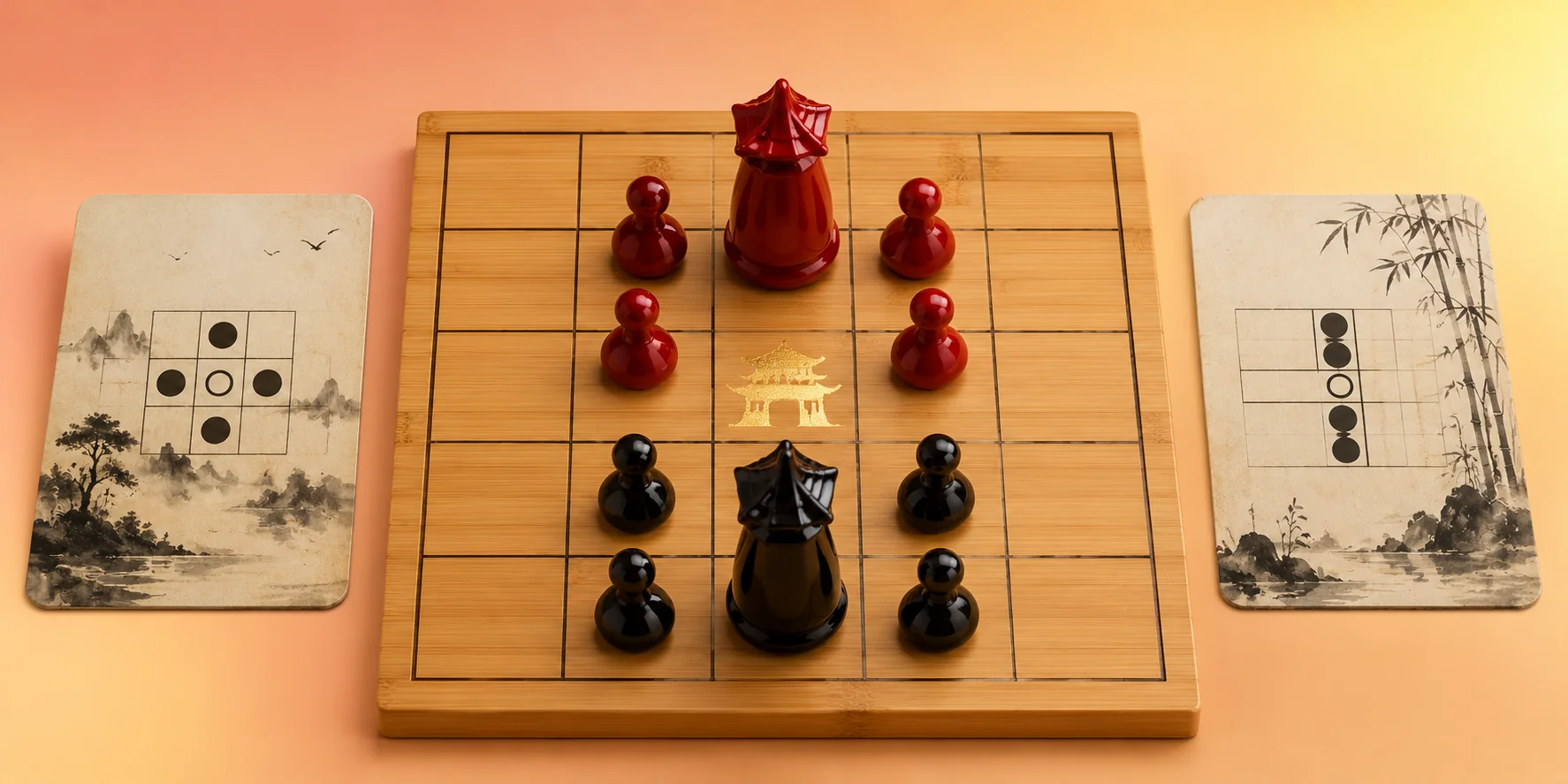
3. Onitama
Why it works: 16-card movement deck means every match is structurally different. Card-rotation mechanic — what you play this turn becomes available to your opponent two turns later — forces multi-turn planning on both sides.
Mobile fit: Small 5×5 board fits perfectly. Five visible cards plus two hand cards is exactly enough information for a phone screen.
Skill curve: Quick to grasp the basics, deceptively deep on the strategy. Hard difficulty bots are genuinely difficult.
Where to play: Pop Play — free, no ads, full guide here.
4. Santorini
Why it works: Move-and-build mechanic on a 5×5 grid creates intense spatial puzzles. You’re racing your opponent to a third-floor win while simultaneously denying their climbs.
Mobile fit: Small board with 3D-ish building visualisation works well on phone screens. Turn pace is quick (8-15 minute matches).
Skill curve: Easy rules, deep tactics. The “should I climb or block?” question evolves throughout each match.
Where to play: Pop Play — free, no ads, full guide here.
5. Mancala (Kalah)
Why it works: One of humanity’s oldest games — and still genuinely strategic. Sowing-and-capturing mechanics are visceral; chain captures feel earned.
Mobile fit: The two-row pit board is perfect for portrait phone screens. Tap-to-sow is a one-action interaction with no complexity.
Skill curve: Easy rules, surprisingly deep counting / planning. The standard 6-pit Kalah variant is solved (first player wins) but human play is still nuanced.
Where to play: Pop Play — free, no ads, full guide here.
6. Checkers (Draughts)
Why it works: A proper classic with a 5,000-year lineage. Multi-jump captures are dramatic; king endgames have their own subgenre of strategy.
Mobile fit: 8×8 board with two-colour pieces reads clearly on phones. Move animations + capture chains are easy to follow.
Skill curve: Easy rules, very deep at high levels (computer-solved as a draw in 2007). Casual play feels balanced; expert play is brutal.
Where to play: Pop Play — free, no ads, full guide here.
7. Abalone
Why it works: Marble-pushing mechanic is utterly unique among major board games. Tight formations vs scattered formations creates a fun spatial-mass strategy.
Mobile fit: Hexagonal board is unusual but works well on phone screens. The push-or-side-step decision per turn is clear.
Skill curve: Moderate. Hard to master because the high branching factor makes precise calculation impractical for humans.
Where to play: Pop Play — free, no ads, full guide here.
8. Gomoku (Five-in-a-Row)
Why it works: Pure pattern recognition. Place stones, build threats, force your opponent to defend while you set up your own win. Deceptively deep.
Mobile fit: 15×15 grid is dense for a phone screen but works because you only place stones — no movement. Pinch-zoom reveals the meta-grid.
Skill curve: Brutal once you’re past beginner. Strong play requires recognising 8-12 multi-stone threat patterns instantly.
Where to play: Pop Play — free, no ads, full guide here.
9. Mega Tic Tac Toe (Ultimate Tic Tac Toe)
Why it works: Tic Tac Toe scaled up with a forced-move rule that turns a children’s game into genuinely strategic depth. Every move sends your opponent to a specific small board.
Mobile fit: 9×9 grid with highlighted destination board is visually clear on phones. Perfect quick-game length (8-15 min).
Skill curve: Easy to start, surprisingly tricky to master. The forced-move structure creates trap setups that feel like puzzle-game wins.
Where to play: Pop Play — free, no ads, full guide here.
10. Sea Battle (Battleship-style)
Why it works: Hidden-information game with a perfect tension structure: place your fleet, deduce theirs. Probability-based decisions with no luck once placement is set.
Mobile fit: Two grids (yours and theirs) is the natural mobile pattern. Tap-to-fire is one-action; ship-sinking is dramatic.
Skill curve: Casual play is luck-heavy; strong play involves careful probability tracking and pattern-search optimisation.
Where to play: Pop Play — free, no ads.
What we left off
Notable omissions and why:
- Chess — best-served by dedicated chess apps (Chess.com, Lichess). Pop Play doesn’t ship chess.
- Go — same, dedicated apps are stronger. Pop Play doesn’t ship Go (we ship Gomoku, which uses the same equipment).
- Backgammon — fantastic 2-player game, but dice-driven enough that a low-skill player vs high-skill player can still win unfairly often.
- Carcassonne / Catan — better on tablets / desktop; mobile screens are too small.
- Dominoes — included implicitly via Pop Play but excluded from the list because it’s more often 4-player than 2-player.
- Snakes & Ladders, Bingo — almost pure luck, no strategic 2-player tension.
Why one app for all of them?
All 10 games above are part of Pop Play, which combines them — plus 9 more — into one app with shared accounts, shared cosmetics, and one matchmaking pool. No ads, no pay-to-win.
Compared to running 10 separate apps:
- One install, one account, one notification settings page.
- Cosmetics carry across games — your equipped board theme works everywhere.
- Matchmaking pools are pooled — your opponent might be sitting in the queue for any of the 19 games, so wait times are typically under 30 seconds in any market.
- No ads, ever. Most “free” mobile board game apps make their money on aggressive interstitials. Pop Play uses optional rewarded video ads only — strictly opt-in.
How to pick from this list
If you want a 5-minute coffee-break game: Connect 4, Quick Ludo, Greedy Dice.
If you want a deep strategic match: Reversi, Onitama, Santorini, Gomoku.
If you want a classic that’s been refined for centuries: Ludo, Checkers, Mancala.
If you want a hidden-information tension game: Sea Battle, Code Breaker.
If you want a family game for varying ages: Snakes & Ladders, Bingo, Connect 4.